
Southeast Asia Extreme Condition Field Study: Broadcast Seeder Powertrain & PTO Shaft Adaptation Guide
Engineered specifically for high-humidity, high-salinity, and extreme corrosive fertilizer application environments in tropical agriculture.
Core Technology Fast Read: Broadcast Seeder Driveline Dynamics
In the rigorous theater of modern agricultural spreading, the PTO drive shaft is the critical mechanical artery transferring engine torque to the spinner discs of a broadcast seeder. Operating in Southeast Asia presents a unique matrix of metallurgical challenges. Standard drivelines often succumb to catastrophic failure within a single planting season when exposed to the highly corrosive dust of urea, NPK compounds, and lime, combined with the relentless 90%+ ambient humidity of monsoon climates. The resulting chemical reactions lead to seized splines, shattered universal joints, and degraded safety guards.
Zhejiang Jiukai Drive Shaft Co., Ltd. relies on over two decades of heavy-duty agricultural transmission research to fundamentally redesign the material science of seeder PTO shafts. By upgrading our forging protocols and integrating aerospace-grade anti-corrosion surface treatments, we have pushed the salt-spray resistance benchmarks far beyond standard industry thresholds. Operating seamlessly at both 540 RPM and 1000 RPM, our driveline systems achieve a 98.5% mechanical efficiency rate. Equipped with precisely calibrated shear bolt yokes or friction clutches, they provide instantaneous overload protection the moment a foreign object or fertilizer clump jams the spreader mechanism, thereby protecting the tractor’s transmission from devastating kinetic shock.
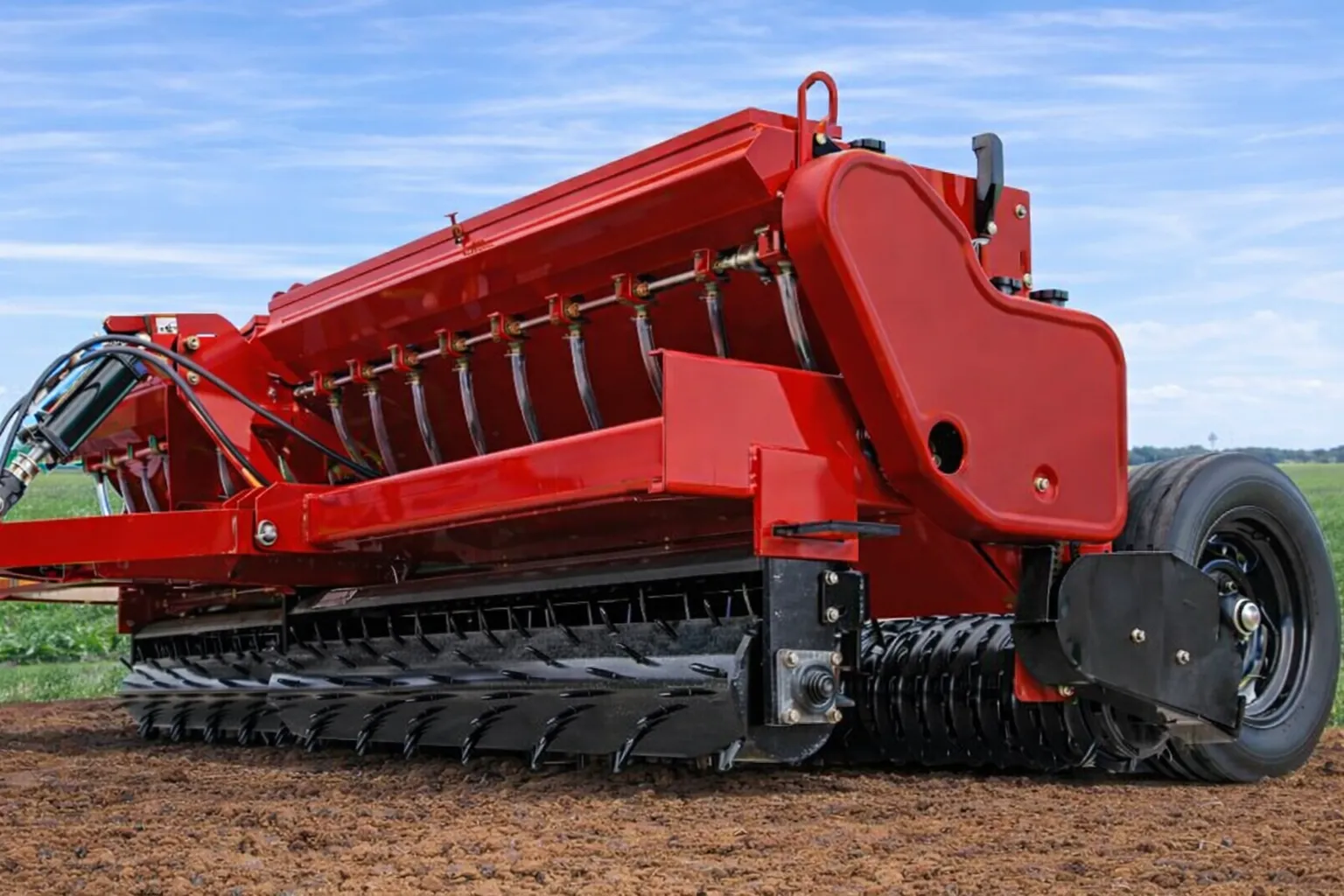
Power Distribution Geometry: How the PTO Shaft Drives the Seeder
A broadcast seeder’s primary function is the uniform centrifugal distribution of seeds or granular fertilizers over working widths ranging from 12 to 36 meters. This operation begins at the tractor’s rear splined output shaft. Torque is engaged and transferred into the PTO drive shaft, traveling down the telescoping profile tubes. Upon reaching the implement end, the rotational energy enters the agricultural gearbox (typically a right-angle bevel gearbox with a 1:1 or 1:1.5 ratio). The gearbox redirects the horizontal torque 90 degrees vertically to spin the agitator and the spinner discs at high velocities.
Client Pain Point & Zhejiang Jiukai Engineering Solution
Client Pain Point: “Our previous aftermarket PTO shafts rusted entirely within three months due to Muriate of Potash (MOP) dust. The telescopic tubes seized, and when we raised the 3-point hitch, the rigid shaft shattered our tractor’s rear bearing housing.”
Zhejiang Jiukai Solution: “By switching to our Series 4 shafts treated with QPQ Salt Bath Nitriding and Triple-lip sealed cross journals, a major farming cooperative in Malaysia eliminated telescopic seizure completely. The shafts maintained smooth sliding under 400 hours of high-corrosion exposure, reducing maintenance downtime by 65% in the first quarter.”
Overcoming Inferior Driveline Deficiencies
- Material Fatigue Breakthrough: Inferior shafts utilizing basic Q235 carbon steel deform under the high starting torque of heavy fertilizer loads. Our yokes are closed-die hot forged from 20CrMnTi alloy steel, carburized and quenched to achieve a core hardness of HRC 35-40 and a surface hardness of HRC 58-62, increasing fatigue resistance by 300%.
- Vibration and Grease Leakage Prevention: Broadcast seeders generate significant high-frequency vibrations. Traditional needle bearings rapidly lose lubrication and burn out. We deploy Triple-lip seal technology coupled with high-temperature polyurea grease, maintaining film integrity even during intense 40°C open-field operations in Thailand.
- Extreme Anti-Corrosion Profiling: To combat acidic fertilizer compounds, our Lemon and Star profile tubes undergo deep galvanization or electrophoretic deposition (E-coating). They endure over 480 hours of salt spray testing without red rust, eradicating the binding issues that plague standard painted shafts.

Precision Forged Yoke and Overload Protection Clutch Assembly
Engineering Technical Specifications for Broadcast Seeder PTO Shafts
The following data points are extracted from Zhejiang Jiukai’s standardized manufacturing database. All parameters support non-standard engineering customization based on exact tractor horsepower and hopper capacity.
| Technical Parameter | Standard Configuration Data | Customizable Range / Engineering Limit |
|---|---|---|
| Application Series Rating | Series 2 to Series 5 (European Standard) | Available from Series 1 up to Series 8 |
| Cross Journal (U-Joint) Dimensions | 23.8 mm x 61.3 mm / 27.0 mm x 74.6 mm | 22.0 mm to 42.0 mm diameter options |
| Nominal Power Transmission (540 RPM) | 15 kW (21 HP) – 35 kW (47 HP) | Maximum support up to 150 kW for heavy implements |
| Nominal Power Transmission (1000 RPM) | 23 kW (31 HP) – 54 kW (74 HP) | Engineering limit peaks at 230 kW |
| Dynamic Torque Rating (Nm) | 210 Nm – 620 Nm | Peak shock load endurance up to 2100 Nm |
| Tractor End Yoke Spline | 1-3/8″ 6-spline with Push-Pin connection | 1-3/8″ 21-spline / 1-3/4″ 6-spline or 20-spline |
| Implement End Safety Device | Shear Bolt Yoke (Recommended for Seeders) | Friction Clutch, Freewheel (Overrunning Clutch) |
| Shear Bolt Breaking Torque | 900 Nm / 1200 Nm (Based on M8/M10 Grade 8.8) | Calibration fine-tuning based on disc inertia |
| Telescopic Tube Profile | Lemon Tube / Triangular Tube | Star Tube / Involute Splined Shaft |
| Overall Closed Length (Lz) | 710 mm / 860 mm / 1010 mm | Custom lengths from 500 mm to 2500 mm |
| Operational Overlap Requirement | Minimum 1/3 of total tube length during rotation | Anti-bending reinforced sleeves for ultra-long strokes |
| Maximum Articulation Angle (Continuous) | Standard U-Joint under 25° | Wide-Angle CV Joint permits momentary 80° turns |
| Surface Anti-Corrosion Treatment | Zinc Primer + Epoxy Powder Coating | Dacromet / QPQ processing for severe fertilizer contact |
| Salt Spray Test Resistance | 240 Hours with zero red rust spots | Marine/Tropical high-grade customization > 500 Hours |
| Safety Guard Material | High-Density Polyethylene (HDPE) Cone & Tube | UV-resistant modified resins with retention chains |
| Guard UV Protection Level | UV-8 Rating (Anti-sunlight embrittlement) | Carbon black stabilizer formulation for equatorial use |
| Lubrication Interval | Grease zerk injection every 50 working hours | Maintenance-free (Lubricated for life) sealed cross joints |
| Yoke Forging Process | Closed-Die Hot Forging | Cold extrusion enhancement for specific flange yokes |
| Dynamic Balancing Grade | G16 Standard Class (ISO 1940-1) | G6.3 High-Precision Class (Mandatory for 1000 RPM) |
| Operating Temperature Range | -20°C to +55°C | Extreme heat/humidity wide-temp grease configuration |
Southeast Asia Agricultural Mechanization Policies & Certification Protocols
As the ASEAN Economic Community (AEC) drives agricultural modernization, individual member states have enacted stringent safety and quality standards for imported agricultural machinery and rotating components. Non-compliant PTO shafts face severe customs blockages or removal from lucrative government subsidy lists.
Thailand – TISI Certification & DOAE Subsidies
Thailand, acting as the agricultural manufacturing hub of Southeast Asia, mandates strict safety oversight via the Thai Industrial Standards Institute (TISI). Our driveline safety guards are fully equipped with anti-rotation retention chains, complying flawlessly with the Department of Agricultural Extension (DOAE) safety regulations, enabling local buyers to qualify for up to 30% government machinery subsidies.
Vietnam – TCVN Standard Compliance
In the complex waterways of the Mekong Delta, broadcast seeders often operate in extremely muddy terrain. Vietnam’s TCVN mechanical safety standards mandate zero-tolerance for entanglement risks. Zhejiang Jiukai provides seamless, fully enclosed resin cones and heavy-duty rust-proof spline sleeves, widely adopted by rice farming cooperatives in Can Tho and Tien Giang provinces.
Indonesia & Malaysia – Palm Oil Plantation Norms
Indonesia’s SNI and Malaysia’s SIRIM certifications focus heavily on the durability of fertilizer spreading equipment used in oil palm plantations. Because fertilizers contain highly corrosive potassium chloride, we supply these markets with specialized high-salt-spray resistant drivelines, aligning with the Roundtable on Sustainable Palm Oil (RSPO) guidelines for safe and efficient operations.
Brand Compatibility & Replacement Disclaimer (Legal Compliance)
Throughout our extensive history serving the global agricultural machinery aftermarket, Zhejiang Jiukai Drive Shaft Co., Ltd. has accumulated a vast database of flange, spline, and cross journal dimensions. Our PTO drive shafts are engineered to be physically and dynamically compatible as aftermarket replacements for broadcast seeders originally equipped with Comer Industries®, GKN Walterscheid®, or Bondioli & Pavesi® drivelines.
Legal Disclaimer: Note: All manufacturer names, trademarks, and OEM part numbers (such as Comer, GKN, Bondioli & Pavesi) mentioned in this article or on this website are for reference purposes only and to facilitate selection. Zhejiang Jiukai Drive Shaft Co., Ltd. is an independent manufacturer and has no direct affiliation, sponsorship, or authorization from the aforementioned brands. We provide independently engineered, equivalent, or upgraded alternative solutions.
Powertrain Selection Guide (Procurement Engineering)
Selecting the incorrect PTO shaft not only leads to financial waste but can result in catastrophic mid-operation fracture. Follow this systematic approach to identify the precise driveline geometry for your broadcast seeder:
| Step 1: Tractor Horsepower & RPM Matching | Broadcast seeders generally require lower horsepower (20-60 HP). Verify the tractor’s PTO output speed. For 540 RPM, Series 2 to Series 4 shafts are standard. If utilizing 1000 RPM, strictly verify that the shaft has G6.3 dynamic balancing to prevent high-frequency vibrations from shattering the seeder’s fiberglass hopper. |
| Step 2: Measure Closed Length (Lz) End-to-End | Raise and lower the seeder on the 3-point hitch to find the shortest and longest distances between the tractor and implement shafts. Purchase based on the Closed Length (Lz), ensuring at least 25mm of compression clearance remains at the shortest point to prevent the shaft from “bottoming out” and destroying the tractor gearbox thrust bearings. |
| Step 3: Identify Yoke Connections | The tractor end is universally a 1-3/8″ 6-spline with a push-pin or pull-collar quick release. The implement side (gearbox input) may be a smooth bore with a keyway requiring a locking bolt, or another splined connection. Use calipers to accurately measure the seeder’s input shaft outer diameter. |
| Step 4: Mandate Overload Protection | Fertilizer clumping is inevitable. Because the spinner discs carry significant rotational inertia, a Shear Bolt Yoke is strongly recommended. Upon a jam, the inexpensive shear pin snaps, instantly decoupling the power. Never use a solid rigid yoke without an external clutch for this application. |
Installation Protocols & Critical Fault Troubleshooting
Broadcast Seeder PTO Installation Steps
- Engine Off & Park Brake: Completely shut down the tractor engine and remove the key. This is a non-negotiable safety perimeter.
- Surface Preparation: Wire-brush the tractor splines and seeder input shaft to remove dried mud, fertilizer residue, and old grease.
- Implement End First: Attach the end containing the safety clutch (Shear Bolt Yoke) to the seeder gearbox. Align the holes and secure the retaining bolt.
- Tractor End Connection: Depress the quick-release push-pin, slide the yoke onto the tractor PTO, and push until an audible “click” confirms the pin is seated in the shaft groove. Pull backward to verify the lock.
- Anchor Safety Chains: Fasten the anti-rotation chains from the plastic guard to stationary points on both the tractor and implement. Leave enough slack for hydraulic lifting.
- Pre-Operation Lubrication: Before initial startup, pump NLGI No. 2 extreme pressure lithium grease into all cross joint zerks and the overlapping section of the telescopic tubes.
Troubleshooting Matrix
- Fault: Violent vibration and metallic knocking sounds during operation.
Root Cause: Phasing error. The inner and outer tubes were pulled apart and reassembled out of phase (yoke ears are not on the same geometric plane), destroying constant velocity dynamics.
Solution: Disconnect the tubes, rotate the inner tube, and align the stamped arrow marks on both tubes before sliding them back together. - Fault: Hydraulic pump whines and the PTO shaft bends when lifting the seeder.
Root Cause: The shaft was not cut short enough. At maximum lift, the tubes bottomed out, generating massive axial thrust into the tractor transmission.
Solution: Stop immediately. Remove the shaft and cut equal lengths from both the inner and outer steel tubes and plastic shields to ensure at least 25mm of clearance at the shortest operating distance. - Fault: Shear bolts snap continuously even when the hopper is empty.
Root Cause: Using low-grade structural bolts instead of factory-spec shear pins, or the seeder’s gearbox bearings have seized due to fertilizer corrosion.
Solution: Inspect the implement for blockages. Replace only with the exact specification (e.g., M8 Grade 8.8) shear bolt. Do not substitute with hardened steel.

Engineer’s Field Notes: 5-Country Southeast Asia Real-World Case Studies
Theoretical data only proves its worth when subjected to mud, heat, and relentless operational stress. The following reports are drawn directly from our technical service team’s field deployments over the past decade, demonstrating how our engineering adapts to extreme localized conditions.
1. Surat Thani, Thailand – Heavy Organic Fertilizer Spreading in Rubber Plantations
Client Pain Point: “Our previous alternative shafts failed when spreading high-moisture chicken manure. The viscous sludge glued the plastic slip rings to the steel tube, causing the safety guard to spin at 540 RPM—a massive safety hazard.”
Engineering Intervention: Based on our 10-year factory data regarding highly viscous agricultural sludge, we engineered a Series 4 shaft featuring Teflon (PTFE) coated self-lubricating nylon slip rings. Field Evaluation: “This driveline has survived three monsoon seasons. The guards remain perfectly stationary, and our safety compliance incidents have dropped to zero.”
2. Mekong Delta, Vietnam – Urea Broadcasting in Submerged Rice Paddies
Client Pain Point: Paddy fields required tractors to navigate deep mud and steep embankment crossings, forcing the mounted seeder into extreme articulation angles. Standard U-joints were snapping under the torque when bent past 30 degrees.
Engineering Intervention: We deployed an 80° Wide-Angle Constant Velocity (CV) joint system on the tractor end, allowing full-power torque transfer during sharp turns without vibration. Field Evaluation: Mr. Le, a cooperative manager in Can Tho, stated: “The wide-angle joint is a revelation. Our operators no longer need to disengage the PTO during tight headland turns, increasing our daily coverage by 15 acres.”
3. Johor, Malaysia – NPK Compound Spreading in Oil Palm Estates
Client Pain Point: High-chloride fertilizer dust settled on the telescopic tubes, absorbed evening dew, and formed a highly acidic electrolyte. The inner tubes rusted completely solid, shattering two 50HP tractor PTO output bearings during lifting.
Engineering Intervention: We initiated an emergency retrofit using Zhejiang Jiukai’s QPQ Salt Bath Nitrided tube profiles, offering 5 times the rust resistance of cold-drawn steel, supplemented with fully enclosed ribbed bellows. Field Evaluation: “Your metallurgy saved our gearboxes. A year later, we pull the tubes apart and the steel remains pristine, with zero galvanic corrosion.”
4. Sumatra, Indonesia – Volcanic Soil Amendment Broadcasting
Client Pain Point: Broadcasting heavy agricultural lime creates immense drag. Lazy operators replaced broken shear bolts with hardened rebar. When a hidden rock jammed the spinner, the resulting shock wave blew the tractor’s PTO transmission casing apart.
Engineering Intervention: We conducted on-site safety training and standardized their fleet with precisely calibrated M8 Grade 8.8 shear bolt yokes, strictly prohibiting non-standard hardware. Field Evaluation: “The factory training and standardized safety clutches restored our operational confidence. The system acts exactly like an electrical fuse—it breaks the bolt, not the machine.”
5. Luzon, Philippines – Typhoon Season Rapid Corn Planting
Client Pain Point: The combination of blistering equatorial sun and torrential monsoon rain caused standard liquid spray paint to blister and flake off within weeks, exposing bare metal to instant oxidation.
Engineering Intervention: We upgraded the finishing process to a dual-layer epoxy electrostatic powder coating, baked in our continuous furnaces to form a highly cross-linked polymer shield. Field Evaluation: A major local distributor reported: “The aesthetic durability is incredible. Even after sitting in an open-air yard for months, the paint hasn’t faded or chipped, building massive trust with end-users.”
Equipment Procurement & Maintenance Technical FAQ
1. Why should a broadcast seeder use a shear bolt yoke rather than a friction slip clutch?
Friction clutches are ideal for continuous overloads (like rotary tillers). However, in seeders, fertilizer dust penetrates the friction plates, absorbs moisture, and causes the plates to rust solid (seize). A shear bolt mechanism is fully enclosed, immune to fertilizer contamination, and provides absolute, binary overload protection.
2. How can I tell if my telescopic tubes have rusted and seized?
If you hear deep metallic groaning or grinding from the rear of the tractor when lifting the implement, or if you notice oil leaking from the tractor’s PTO seal, the tubes are likely binding. Stop operations immediately, detach the shaft, and attempt to slide it by hand. If it won’t move, replace the tubes.
3. Can your plastic safety guards survive the extreme UV radiation in Southeast Asia?
Absolutely. Our safety guards are injection-molded from modified High-Density Polyethylene (HDPE) infused with advanced UV stabilizers. They pass stringent UV-8 rating tests, ensuring they will not become brittle, crack, or disintegrate even after prolonged exposure to equatorial sunlight.
4. What is the correct lubrication interval for a seeder PTO driveline?
Standard protocol dictates pumping grease into the cross journal zerks every 50 working hours. The sliding surfaces of the telescopic tubes should be cleaned and greased every 100 hours. The safety guard slip rings also require a light application of grease every 50 hours to prevent melting.
5. Which is better for a seeder: Lemon profile tubes or Star profile tubes?
Both easily handle a seeder’s torque requirements. Star tubes offer more contact area and slightly better dust sealing. However, field feedback from Southeast Asia indicates that Lemon tubes are easier to clean and re-grease manually when caked with wet fertilizer, making them highly practical.
6. How exactly do I cut the PTO shaft to the correct length?
Never guess the length. Mount the seeder and level it to find the shortest possible distance between the tractor and implement shafts. Mark the overlap. You must cut the exact same amount of material from the outer steel tube, the inner steel tube, and both plastic guard tubes to maintain dynamic balance.
7. If I am importing to Indonesia, how do you prevent rust during ocean transit?
We utilize Volatile Corrosion Inhibitor (VCI) vacuum-sealed bagging for all Southeast Asian exports. Combined with industrial desiccants inside heavy-duty wooden crates, our shafts can endure up to 6 months of high-salinity, high-humidity ocean freight and warehouse storage without a single speck of rust.
8. We want to run our seeder at 1000 RPM for a wider spread. Can we use the old 540 RPM shaft?
This is extremely dangerous. Doubling the rotational speed quadruples the centrifugal forces. A shaft balanced for 540 RPM lacks the G6.3 dynamic balancing tolerance required for 1000 RPM. It will vibrate violently and potentially shatter. You must procure a dedicated high-speed driveline.
9. Can I repair a broken shaft by only replacing the cross journal (U-joint)?
Yes. Our drivelines feature modular engineering. We provide dedicated cross journal repair kits (including needle bearings and snap rings). As long as the yoke ears have not been stretched or worn into an oval shape, replacing just the U-joint is a highly economical maintenance strategy.
10. Do you offer OEM customization for our proprietary seeder manufacturing lines?
Absolutely. As a fully integrated manufacturing entity, we support comprehensive non-standard customization. Whether you need specific flange dimensions, proprietary shear pin calibrations, or custom paint colors to match your brand identity, our R&D team can deliver prototypes within 15-20 working days.
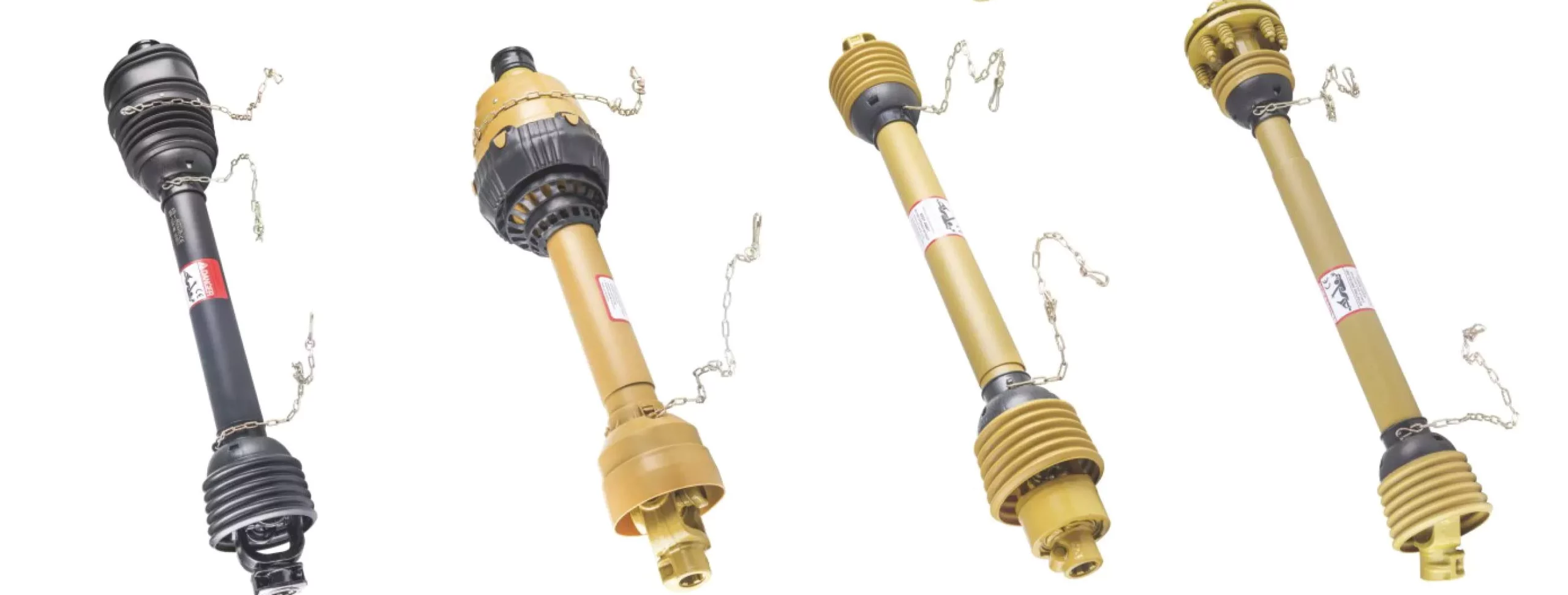
The Mechanical Nucleus: Deep Dive into Agricultural Gearboxes & Components
In the anatomical architecture of a broadcast seeder, a formidable PTO driveline is only half the equation. The terminus of that torque—the mechanism that translates horizontal rotational energy into the vertical, high-speed centrifugal force required to scatter seeds and fertilizer—is the Agricultural Gearbox. As an inseparable core component of the power transmission ecosystem, Zhejiang Jiukai does not merely forge shafts; we possess profound metallurgical and precision-machining capabilities in heavy-duty gearboxes, providing OEMs with a seamless, end-to-end “Shaft-to-Box” powertrain solution.
Engineering Analysis of Right-Angle Bevel Gearboxes for Seeders
The operational soul of a broadcast seeder lies in its centrifugal spinner disc. Our dedicated Bevel Gearbox designs focus intensely on resolving three primary agricultural engineering pain points: extreme abrasive dust intrusion, massive radial dynamic loads on the vertical output, and the demand for zero-maintenance operation in remote fields. Unlike industrial gearboxes housed in climate-controlled factories, agricultural gearboxes endure torrential rains laced with highly electrolytic fertilizer compounds.
Housing Metallurgy and Anti-Corrosive Armor: specifically for the humid Southeast Asian market, we have transitioned away from standard gray cast iron, which is prone to porosity and rapid oxidation. Instead, we utilize high-tensile Aluminum Alloy die-casting or Nodular Cast Iron (Ductile Iron QT450-10) treated with multi-layer epoxy baking paint. The aluminum housing significantly reduces the implement’s rear overhanging weight (minimizing soil compaction) while naturally offering exceptional resistance to chemical fertilizers and superior thermal dissipation, ensuring internal gear oil temperatures rarely exceed 75°C even during continuous heavy-load urea spreading.
Core Gear Metallurgy and AGMA Standards: The internal straight or spiral bevel gears are the frontline soldiers absorbing kinetic shock. We reject low-cost powder metallurgy. Instead, we strictly specify 20CrMnTi premium carburizing alloy steel. Through closed-die forging, we achieve dense, unbroken metal grain flow lines. The gears are then processed in multi-purpose atmospheric furnaces for deep carburizing and quenching to a case depth of 0.8-1.2mm. Post-heat treatment, the teeth undergo precision grinding or honing to achieve an AGMA Class 9 or higher meshing accuracy. This microscopic precision not only eradicates harsh mechanical whining but physically elevates power transmission efficiency to 97%, guaranteeing every drop of diesel fuel is converted into optimal spreading width.
The Ultimate Defense: Bearing Architecture and Double-Lip Seal Arrays: The spinner disc mounts directly to the gearbox’s vertical output shaft. Because granular fertilizer often feeds unevenly from the hopper, the rapidly spinning disc generates severe Eccentric Excitation Force and immense radial loads. We counteract this by deploying oversized, high-load Tapered Roller Bearings. At the shaft exits, we install Fluororubber (FKM) or Nitrile Butadiene Rubber (NBR) composite Double-lip Oil Seals. The outer dust lip acts as an impenetrable shield, scraping away mud and abrasive NPK dust; the inner lip hydrodynamically locks the extreme pressure (EP90 or 80W-90) gear oil inside, permanently eradicating the industry-wide plague of seal leaks and burnt-out gears.
For advanced Twin-Disc Spreaders, we engineer complex central splitter gearboxes (1 Input, 2 Outputs). Integrating precise speed ratios (such as 1:1, 1:1.21, or 1:1.5), these units simultaneously drive the hopper agitator while rotating the twin spinner discs in synchronized, counter-rotating motions, generating a perfectly overlapped, flawless semi-circular spreading pattern devoid of any application blind spots.

Corrosion-Resistant Aluminum Alloy Spreader Gearbox

Multi-Axis Torque Distribution Gearbox Assembly
Peripheral Power Transmission Component Ecosystem
Beyond drivelines and gearboxes, we provide a comprehensive suite of premium kinetic accessories to manage secondary power routing within seeders, balers, rotary tillers, and combine harvesters, empowering engineers to build highly resilient mechanical ecosystems.
Precision Sprockets
Featuring high-frequency induction hardened teeth (HRC 40-50) to resist severe abrasive wear in dusty environments. Engineered to ANSI and DIN standards, providing ultra-quiet, synchronous engagement with standard roller chains.
Heavy-Duty Gears
Spur, helical, and bevel gears forged from premium alloy steel. We strictly control grain size and non-metallic inclusions. Available with nitriding and carburizing treatments for infinite fatigue life in complex harvester transmissions.
Industrial Roller Chains
Reinforced O-ring and X-ring roller chains engineered explicitly for muddy agricultural mechanics. Pins undergo polarization, and plates are shot-peened to combat metal fatigue caused by massive kinetic startup shocks.
Taper Lock Pulleys
Machined from high-grade cast iron or steel for V-belt drives. Dynamically balanced to ISO 4183 standards. The integrated taper bushing system allows for rapid, keyless installation, drastically reducing field maintenance downtime.
The Architects of Non-Standard Driveline & Kinetic Customization
From ultra-durable PTO shafts to masterfully meshed Agricultural Gearboxes, Zhejiang Jiukai Drive Shaft Co., Ltd. operates a 20,000-square-meter intelligent manufacturing facility. Equipped with advanced CNC arrays, dynamic balancing laboratories, and destructive torque testing centers, we are not mere warehouse distributors; we are a foundational manufacturing entity with decades of metallurgical pedigree.
Whether your machinery is battling the monsoon mud of the Philippines or the acidic fertilizer dust of a Malaysian plantation, our senior engineering task force is prepared. We welcome global OEMs to provide blueprints, samples, or conceptual challenges for extreme environments. We offer full lifecycle non-standard manufacturing, from 3D kinematic modeling to rapid physical prototyping.


Initiate Your Engineering Customization Inquiry Now
Email: [email protected] | Dedicated B2B Technical Support | Explore Our Global Capabilities