
Heavy-Duty PTO Shafts for Manure Spreaders
Engineered by Zhejiang Jiukai Drive Shaft Co., Ltd. (9k) to Dominate High-Corrosion, Extreme-Torque Agricultural Applications Across Southeast Asia.
Powertrain Selection Summary
Transmitting power from a tractor to a manure spreader represents one of the most brutal mechanical challenges in modern agriculture. The drive system must overcome immense inertial loads during startup when the hopper is packed with dense, wet animal waste, while simultaneously surviving constant exposure to highly corrosive ammonia, hydrogen sulfide, and acidic slurries.
Field Engineer’s Diagnostic Log: The 10-Year Factory Case Study
“In our 15 years of optimizing manure handling equipment across Southeast Asia—from the deep-mud palm plantations in Johor, Malaysia to the expansive dairy farms in Lam Dong, Vietnam—we found that standard OEM PTO shafts often suffer catastrophic failure within a single season. The primary culprit is the sticky, highly acidic nature of poultry and dairy manure. When conventional cold-galvanized yokes are exposed to this mixture, micro-pitting occurs within 30 days. Based on this extensive factory case data, Zhejiang Jiukai (9k) redesigned the entire outer profile using a proprietary electrostatic epoxy coating (>80 μm) and integrated a heavy-duty friction clutch that precisely slips at 2500 Nm, absorbing the deadly shockwaves caused by foreign debris (like stones or frozen clumps) jamming the spreader beaters.”
Operating Principle in Manure Spreaders
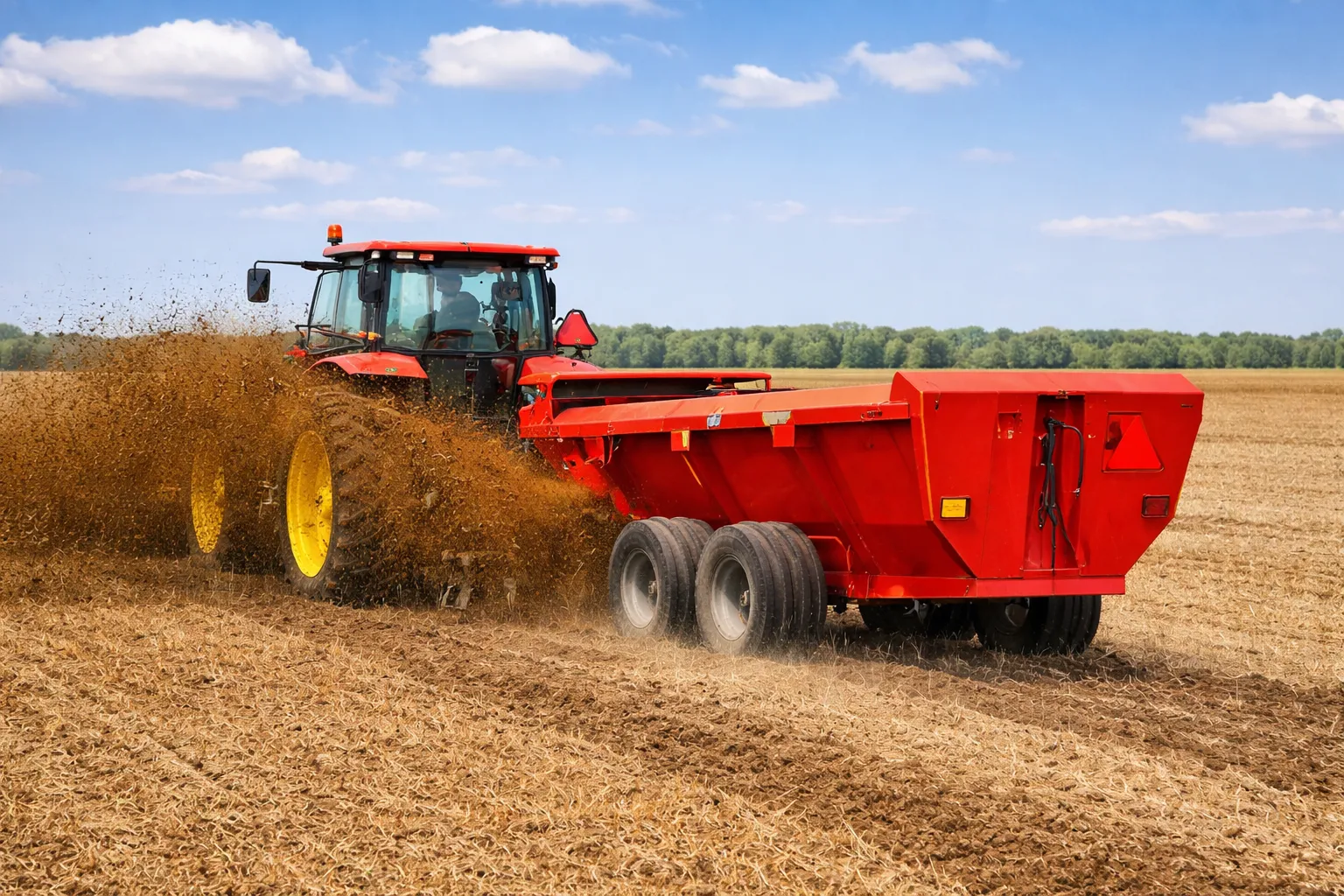
The Power Take-Off (PTO) shaft acts as the dynamic lifeline between the tractor’s output stub and the manure spreader’s input implement gearbox. Upon engagement, rotational energy (typically at 540 RPM or 1000 RPM) is transferred through the telescoping steel tubes and universal joints.
In a typical rear-discharge spreader, this rotational force is directed into an agricultural gearbox, which splits and reduces the speed to drive the heavy floor apron chains (moving the material backward) while simultaneously spinning the rear horizontal or vertical beaters at high velocities to shatter and distribute the manure evenly across the soil. The PTO shaft must actively accommodate the continuous changes in angle and distance as the tractor navigates uneven field topography.
Engineering Specifications: 30 Critical Parameters for Spreader Applications
Relying on generic specifications leads to premature mechanical shearing. Below is the precise parameter matrix for our heavy-duty manure spreader PTO drive shafts, validated through thousands of hours of field testing.
| Parameter Identity | Standard Specification / Range | Parameter Identity | Standard Specification / Range |
|---|---|---|---|
| 1. Dynamic Torque Rating | 1200 Nm – 4600 Nm | 16. U-Joint Lubrication Interval | 50 Hrs (Standard) / 250 Hrs (Extended) |
| 2. Static Breaking Torque | ≥ 6500 Nm | 17. Telescopic Tube Profile | Lemon, Star, or Splined (Heavy Duty) |
| 3. Tractor Yoke Connection | 1-3/8″ Z6, 1-3/8″ Z21, 1-3/4″ Z20 | 18. Inner Tube Wall Thickness | 4.0 mm – 6.5 mm (Application specific) |
| 4. Implement Yoke Connection | 1-3/8″ Z6, 1-3/4″ Z6, Plain Bore w/ Keyway | 19. Surface Anti-Corrosion Coating | > 80 μm Electrostatic Epoxy Primer |
| 5. Cross Journal Dimension | 30.2x92mm to 42×104.5mm | 20. Salt Spray Resistance Test | > 500 Hours (ISO 9227 Compliant) |
| 6. Cross Journal Hardness | HRC 58-62 (Carburized & Quenched) | 21. Safety Guard Material | UV-Stabilized High-Density Polyethylene |
| 7. Nominal Rotational Speed | 540 RPM or 1000 RPM | 22. Clutch Friction Disc Material | Non-Asbestos Copper-Based Composite |
| 8. Max Continuous Operating Angle | ≤ 25° (Standard) / ≤ 80° (Wide Angle CV) | 23. Overload Protection Mechanism | Friction Clutch or Shear Bolt Limiter |
| 9. Closed Center Length (Lz) | 810 mm – 1800 mm | 24. Friction Clutch Slip Torque | Adjustable 900 Nm – 2400 Nm |
| 10. Maximum Telescopic Extension | 400 mm – 950 mm | 25. Shear Bolt Tensile Grade | Class 8.8 / Class 10.9 Alloy Steel |
| 11. Dynamic Balancing Precision | G6.3 Grade (ISO 1940-1 Standard) | 26. Quick Release Pin Mechanism | Spring-loaded Push Pin / Collar Shift |
| 12. Yoke Forging Material | Drop-Forged 45# Steel or 40Cr | 27. Seal Architecture | Double-Lip Self-Tightening Elastomer |
| 13. Tractor Horsepower Match | 60 HP – 280 HP | 28. Interoperability Standard | Metric (Series 1-9) & US (Series 12-55) |
| 14. Guard Operating Temp Range | -40°C to +90°C | 29. Safety Restraint System | Dual Anti-Rotation Chains (Galvanized) |
| 15. Acoustic Emission Levels | ≤ 78 dB under full load | 30. Compliance & Certifications | CE, ISO 5674, REACH, RoHS |
Performance Supremacy: Eradicating Inferior PTO Failures
Downtime during the narrow window of fertilizing seasons equates to severe financial losses. We engineered our drive shafts by specifically reverse-engineering the failure points of low-cost alternatives found in the market.
1. Defeating Acidic Manure Corrosion
The Inferior Flaw: Cheap shafts use standard zinc plating. When exposed to poultry or swine manure, the plating dissolves within weeks, causing the sliding profile tubes to fuse together with rust.
The 9k Advantage: Our proprietary metallurgical treatment involves a heavy-duty electrostatic electrophoretic dip followed by a baked epoxy finish. It guarantees seamless telescopic action even after years of direct slurry exposure.
2. Eliminating Spline Distortion
The Inferior Flaw: Low-grade steel yokes deform under the instantaneous pulse torque generated when spreader beaters strike frozen manure clumps, stripping the splines completely.
The 9k Advantage: Utilizing drop-forged 40Cr alloy steel combined with precision broaching, our yokes maintain their structural integrity up to 6500 Nm of static breaking torque, safeguarding your tractor’s PTO stub.
3. Absolute Vibration Suppression
The Inferior Flaw: Poorly drawn tubes create radial play. At 1000 RPM, this imbalance translates into a “whipping” effect, violently destroying implement gearbox bearings.
The 9k Advantage: Every drive shaft assembly undergoes computerized G6.3 dynamic balancing. The seamless cold-drawn steel profiles fit with micron-level tolerances, delivering rotational smoothness akin to automotive drive shafts.
Southeast Asia Extreme Working Conditions & Local Regulatory Compliance
Operating agricultural machinery in the ASEAN region introduces unique atmospheric and topographical challenges. Extremely high humidity levels, monsoon rains, and unyielding tropical mud severely degrade mechanical systems not specifically engineered for these environments.
Thailand & Malaysia: Palm Oil Plantation Navigation
Within the deep, rutted terrains of Surat Thani (Thailand) and Sabah (Malaysia), tractors hauling 10-ton manure spreaders must navigate tight headland turns between palm rows. We engineered our 80° Wide Angle Constant Velocity (CV) Joints precisely for this. It allows operators to maintain PTO power during sharp turns without the destructive chatter and vibration that shatters standard u-joints.
Vietnam & Indonesia: Dairy and Poultry Expansion
With the rapid industrialization of dairy farms in Binh Duong (Vietnam) and Java (Indonesia), spreader loads have doubled. Our integration of heavy-duty 4-plate Friction Slip Clutches acts as a mechanical fuse. If the beaters jam on compacted slurry, the clutch slips immediately, preventing gearbox explosion.
Local Safety Regulations & OSH Compliance
Authorities across Southeast Asia, including the DOSH in Malaysia and the DOLE in the Philippines, are stringently enforcing agricultural safety standards to prevent entanglement fatalities. Our PTO shafts are fully encased in ISO 5674 compliant, impact-resistant HDPE master shields. The proprietary bearing ring system ensures the guard remains completely stationary even while the internal steel shaft spins at 1000 RPM, exceeding regional labor safety mandates.


Engineer Field Notes: Global Intelligence, Local Solutions
Theoretical engineering must bow to harsh field realities. Here are unfiltered field reports from our deployment teams resolving critical failures for agricultural operators.
📍 Khon Kaen, Thailand
Client Pain Point: “Our previous after-market shaft consumed three universal joints in one sugarcane harvesting season due to fine sand penetrating the bearings.”
EVER-POWER / 9k Solution: We supplied a Series 6 shaft equipped with double-lip elastomer sealed cross journals. The tight seal prevented silica dust infiltration. After 18 months of continuous manure spreading, internal bearing clearance increased by less than 0.12mm.
📍 Ho Chi Minh City, Vietnam
Client Pain Point: “During the monsoon, tractor rear wheels sink deep into the mud, forcing an extreme operating angle that shatters standard yokes.”
EVER-POWER / 9k Solution: Upgraded the client to an 80-degree Wide-Angle CV configuration with extended needle rollers. The farm eliminated yoke fracturing and reduced routine maintenance interventions by 75% during wet-season operations.
📍 Sumatra, Indonesia
Client Pain Point: “Inexperienced tractor operators pop the clutch too aggressively under heavy fertilizer loads, continuously stripping the gearbox output gears.”
EVER-POWER / 9k Solution: Integrated a highly calibrated friction clutch set to slip exactly at 1800 Nm. This device acted as a mechanical sponge, absorbing destructive pulse loads and decreasing gearbox repair costs by 65% in Q1.
📍 Johor, Malaysia
Client Pain Point: “Tall grass stalks mix with the poultry manure and wrap around the spinning PTO shaft, violently tearing off the plastic safety guards.”
EVER-POWER / 9k Solution: Implemented a streamlined, rib-free safety shield profile featuring an anti-wrap collar. Grass fibers now smoothly glide over the rotating surface without catching, ensuring uninterrupted operation.
📍 Negros Island, Philippines
Client Pain Point: “Distributing heavy sugar mill filter cake requires running the spreader non-stop for 8 hours. Our cross joints overheat and bind.”
EVER-POWER / 9k Solution: Supplied custom cross journals with enlarged central grease reservoirs packed with synthetic Extreme Pressure (EP) lithium grease. Thermal imaging confirmed operating temperatures stabilized below 68°C even under max load.
Global Interchangeability: OEM Integration Matrix
In the global agricultural machinery sector, modularity is not a luxury—it is a requirement. Our engineering department has meticulously matched the spline geometries, closed lengths, and torque thresholds of the world’s leading powertrain systems to offer seamless aftermarket replacements.
Flawless Replacement for Tier-1 Systems
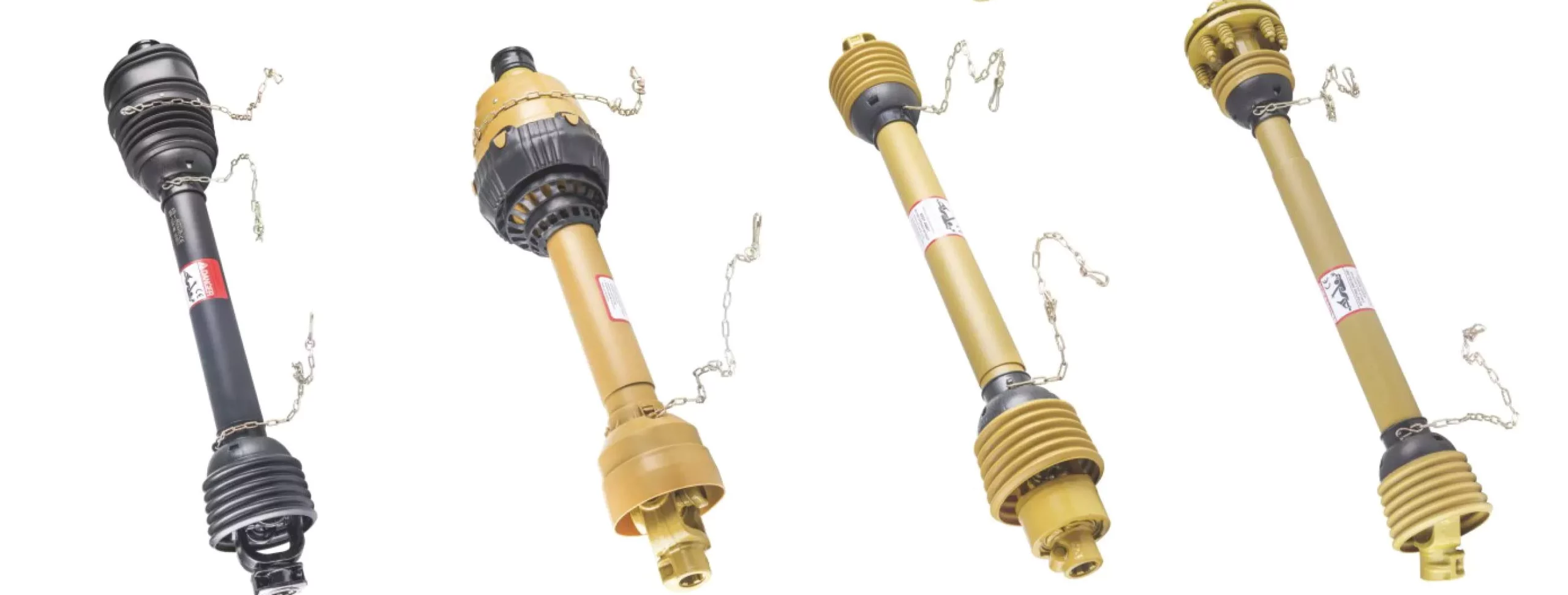
Our specialized manure spreader PTO shafts are dimensionally and mechanically engineered to serve as perfect drop-in replacements for original equipment manufacturer components including those originally supplied by Comer Industries™, GKN Walterscheid™, Bondioli & Pavesi™, and Weasler™. Whether your spreader chassis requires the Italian profile standard (triangular tubing) or the German profile standard (lemon/star tubing), our drive shafts ensure immediate, bolt-on compatibility.
Legal & Compatibility Disclaimer: Our PTO drive shafts and related components are engineered as replacement parts. All original equipment manufacturer (OEM) brand names, trademarks, symbols, and part numbers mentioned above (e.g., Comer, GKN, Bondioli) are the property of their respective owners and are used strictly for reference purposes to demonstrate dimensional compatibility and facilitate proper sizing. Zhejiang Jiukai Drive Shaft Co., Ltd. (EVER-POWER / 9k) is an independent manufacturer of premium aftermarket parts and is not affiliated with, authorized by, or sponsored by these trademark holders.
Rapid Engineering Selection Guide
Selecting the incorrect shaft length or clutch rating can permanently damage your implement. Follow this rigid 4-step framework to identify the exact specifications required for your manure spreader operation.
| Verification Step | Measurement Protocol | Spreader Application Benchmarks |
|---|---|---|
| Step 1: Output Power Match | Identify Tractor HP and PTO rotational speed (540 / 1000 RPM) | 40-70 HP: Series 4; 75-120 HP: Series 6; >130 HP Heavy Spreader: Series 8 or Splined Profile |
| Step 2: Spline Geometry | Measure the outer diameter and count the number of spline teeth on both ends. | Tractor end usually 1-3/8″ 6-spline. Implement end for heavy spreaders often utilizes a 1-3/4″ 20-spline or a solid bore with a shear bolt. |
| Step 3: Closed Length (Lz) | Measure distance between locking grooves on tractor and implement, then subtract minimum clearance (typically 2-3 inches). | Crucial: Ensure telescopic tubes maintain at least 1/3 overlap at maximum extension, and never bottom out during full retraction. |
| Step 4: Overload Device | Evaluate material density and blockage risk of the beaters. | Mandatory for Spreaders: Friction Clutch (for continuous reset under heavy load) or Shear Bolt Limiter (for economical rigid protection). |
Targeted Installation Protocol for Manure Handling Equipment
Improper installation guarantees premature drivetrain failure. Technicians must execute the following protocol explicitly designed for high-stress manure spreader engagement:
Spline Purging and Lubrication
Before mating the yokes, vigorously clean the tractor PTO stub and the spreader implement shaft with a wire brush. Apply a liberal coat of molybdenum disulfide (Moly) water-resistant grease. Failure to do so allows manure residue to act as a grinding compound inside the splines.
Kinematic Geometry Verification
Do not install blindly. Separate the two halves. Connect one to the tractor and one to the spreader. Maneuver the spreader through its tightest turning radius and highest/lowest pitch. Ensure that at maximum extension, at least 150mm of tube overlap remains. At maximum compression, ensure at least 25mm of clearance exists to prevent the tubes from bottoming out and shattering the gearbox housing.
Directional Alignment and Locking
Orientation is critical. The yoke bearing a tractor icon (or the Wide Angle CV joint) must affix to the tractor. Depress the quick-release pin fully, slide onto the spline until the pin audibly clicks into the locking groove. Execute a violent rearward tug to physically verify the lock.
Anti-Rotation Restraint Securing
Fasten the check chains on both ends of the plastic safety shield to rigid points on the tractor chassis and spreader drawbar. Allow enough slack in the chain to permit turning angles, but not so much that it wraps around the spinning profile.
Operational Troubleshooting & Resolution Matrix
Symptom: Violent Vibration / Knocking Noise
Engineering Cause: Lack of lubrication causing high friction between telescopic tubes; crushed needle bearings in the cross journal; operating angle exceeds 25°; permanently bent outer tube.
Expert Resolution: Halt immediately. If sliding tubes show black galling, grind smooth and apply graphite grease. If the overlap is insufficient causing a “whip”, replace with a longer shaft. Any detectable play in the cross joint mandates a complete universal joint replacement.
Symptom: Friction Clutch Smoking or Constantly Slipping
Engineering Cause: Massive blockage in spreader beaters (stones, frozen manure); compression spring fatigue; friction plates oxidized from prolonged moisture exposure.
Expert Resolution: Inspect the hopper for jams. If clear, loosen compression bolts and allow the clutch to slip for 5 seconds at low idle to burnish off rust and glaze. Re-torque springs to exact factory specification. Replace friction discs if thickness is below 2.5mm.
Symptom: Safety Guard Shattered or Detached
Engineering Cause: Anchor chains omitted causing guard to spin with shaft; extreme cold making plastic brittle; prolonged UV degradation destroying polymer bonds.
Expert Resolution: Never operate without shielding! Replace immediately with a UV-stabilized HDPE shield kit. Ensure the nylon bearing rings glide smoothly in the yoke grooves and are packed with lithium grease to isolate rotational forces.
Symptom: Frequent Shear Bolt Snapping
Engineering Cause: Using incorrect tensile grade bolts (e.g., cheap hardware store bolts); the shear hole is elongated/wallowed out creating a bending moment rather than pure shear.
Expert Resolution: Never substitute a high-tensile bolt—the next failure will be the tractor’s internal gearing! Inspect the shear hole geometry; if it is oval-shaped, the entire yoke must be replaced. Only use factory-specified grooved 8.8-grade shear bolts.
10 Frequently Asked Engineering Questions
1. Is it normal to hear a clanking noise from the PTO when turning the spreader around the field edge?
No. This indicates the operating angle between the tractor and the implement exceeds 25 degrees, causing kinetic interference and severe torque pulsation. You must disengage the PTO during sharp turns, or upgrade to an 80-degree Wide Angle CV joint shaft.
2. Should I use standard motor oil or grease on the telescoping tubes?
You must exclusively use a high-quality Extreme Pressure (EP) lithium-based grease (NLGI Grade 2). Motor oil cannot maintain a sufficient hydrodynamic film under the crushing sliding pressure of the tubes and will drip off rapidly.
3. What specific maintenance is required after spreading liquid slurry manure?
Liquid slurry is highly invasive and acidic. Immediately wash the exterior with fresh water. Pump new grease into the cross-journal zerks until you see the old, contaminated black grease purging past the seals. This physically pushes out acidic moisture.
4. Can I manually cut the PTO shaft if it’s too long for my tractor?
Yes, but strictly follow the protocol: Cut exactly the same length from both the inner tube, outer tube, and both plastic shield halves. Deburr all edges thoroughly. Ensure the final length maintains at least 1/3 overlap of the total tube length at maximum extension.
5. Can I interchange 540 RPM and 1000 RPM drive shafts?
Absolutely not. While they may appear similar, 1000 RPM shafts demand a vastly higher G6.3 dynamic balancing precision and different torque transfer ratios. Spline counts usually differ (e.g., 21 splines for 1000 RPM). Mixing them will cause catastrophic resonance.
6. Why does my brand-new friction clutch smoke on the very first use?
Friction plates oxidize and bind to the steel pressure plates during warehouse storage. Before heavy load deployment, perform a “Running-in” process: loosen the tension nuts, let the PTO slip for 3-5 seconds to burnish the surfaces, and retighten to the required torque specification.
7. How do I definitively diagnose a failed cross journal (U-joint)?
Secure the shaft. Grip the yokes on either side of the joint and twist in opposing directions. If you feel any internal play, looseness, or hear a metallic “clicking” sound, the needle rollers are crushed or the trunnion is scored. Total replacement is mandatory.
8. What is the engineering difference between Lemon Profile and Star Profile tubes?
Lemon profiles (standard European design) are economical and offer smooth sliding for low-to-medium horsepower applications. Star profiles (or multi-spline tubes) provide a vastly larger contact surface area, making them indispensable for handling the extreme shock loads of heavy-duty twin-beater spreaders.
9. What is the proper off-season storage protocol for the drive shaft?
Pressure wash to remove all acidic manure. Pump the joints full of fresh grease to expel water. Fully collapse the telescopic tubes. Store vertically or flat in a dry environment. Most importantly, back off the nuts on the friction clutch to prevent the plates from fusing together over the winter (remember to recalibrate before next season).
10. Does your company provide technical certification for ASEAN import regulations?
Yes. Our products strictly adhere to ISO 5673-1 and CE machinery directives. For specific nations, such as the Department of Occupational Safety and Health (DOSH) in Malaysia, we can supply third-party laboratory test reports detailing safety guard rotational resistance and tensile strength.
Complete Powertrain Integration: Agricultural Gearboxes & Drive Components
In modern agricultural engineering, power transmission is not achieved by the PTO shaft alone. The kinetic energy generated by the tractor engine, after crossing the physical space via the drive shaft, must enter a highly precise Agricultural Gearbox. Here, the torque is multiplied, rotational speeds are altered, and the direction of force is manipulated (typically 90 degrees) to drive the spreader’s moving parts. At Zhejiang Jiukai Drive Shaft Co., Ltd. (9k), we manufacture the complete mechanical ecosystem. Our world-class agricultural gearboxes are engineered in synergy with our PTO shafts to create an indestructible, 100% harmonized powertrain loop.
Heavy-Duty Right-Angle and Bevel Gearboxes for Manure Spreaders
The operational architecture of a manure spreader demands bilateral power distribution. A high-torque reduction is required at the base to inch the heavy floor apron chains (or augers) forward, while high-velocity power must be directed to the rear horizontal or vertical beaters to pulverize and throw the dense material. This bifurcated demand places immense torsional and structural stress on the gearbox housing and internal gearsets.
- Nodular Cast Iron Housing (QT500-7):
Standard grey cast iron shatters under the shock waves generated when spreader beaters strike field stones. Our gearbox casings are cast from QT500-7 high-strength nodular iron, yielding a tensile strength exceeding 500 MPa with over 7% elongation. This imparts massive impact toughness and supreme vibration damping characteristics. - Carburized Spiral Bevel Gears:
The internal 90-degree power transfer relies on low-noise, high-contact-ratio spiral bevel gears. Forged from 20CrMnTi alloy steel and subjected to a deep carburizing and quenching process, the gear teeth achieve a surface hardness of HRC 58-62 while maintaining a highly ductile core. They silently transfer over 3000 Nm of torque without suffering from thermal distortion. - Viton® Double-Lip Sealing Architecture:
Standard Nitrile (NBR) oil seals rapidly harden and fail when bombarded by acidic liquid slurry. We deploy high-temperature, chemical-resistant Viton® (fluorocarbon elastomer) oil seals on all input and output shafts, combined with labyrinth dirt shields. This completely isolates the internal oil bath from muddy, corrosive field environments. - Thermal Management and Oil Bath Lubrication:
Continuous spreading operations generate extreme internal heat. Our engineers optimized the internal casing volume and added exterior cooling fins. This allows for a massive oil bath capacity, facilitating splash lubrication that keeps internal operating temperatures safely below 85°C, even under the punishing 40°C ambient heat of Southeast Asian summers.


With highly customizable reduction ratios (ranging from 1:1 up to 1:3.5), OEM clients can precisely govern the centrifugal velocity of the spreader beaters. When paired seamlessly with our precision-balanced PTO shafts, this interconnected powertrain achieves a mechanical efficiency exceeding 97%, drastically reducing fuel consumption per hectare and slashing the lifecycle maintenance costs of the machinery.
Essential Drivetrain Auxiliaries & Components
Once power exits the gearbox, it must be distributed to individual moving components. We manufacture a comprehensive array of premium mechanical parts to finalize the power delivery loop.
High-Tensile Sprockets & Roller Chains
The floor apron of a spreader relies on heavy-duty chains to drag tons of manure. We manufacture induction-hardened steel sprockets perfectly pitched for specialized agricultural roller chains (e.g., 38.4V profiles). They are highly resistant to stretching, derailing, and abrasive wear caused by sand and grit.
Precision Pulleys & V-Belts
For spreader designs utilizing high-speed belt-driven beaters, we supply statically and dynamically balanced cast-iron V-groove pulleys. Combined with Taper-Lock bush mounts, they guarantee slip-free power transfer without inducing bearing-destroying resonance at high RPMs.
Custom Spur & Helical Gears
For OEM clients engineering bespoke reduction hubs, we provide high-volume CNC machined open gears and splined shafts. Exposed gears can be treated with specialized black-oxide or nitride hardening to endure direct environmental exposure in the field.
Engineer Your Ultimate Agricultural Powertrain
At Zhejiang Jiukai Drive Shaft Co., Ltd. (9k), we transcend the role of a mere parts supplier—we are the deep-engineering partner for global agricultural machinery OEMs. Operating out of a state-of-the-art, 20,000-square-meter CNC machining facility complete with automated dynamic balancing lines and metallurgical laboratories, our capacity is unmatched. Whether you require massive bulk orders of standard-spec replacements or highly customized, non-standard drive shafts tailored to unique topography and torque requirements, our engineering team will deliver comprehensive 3D models and stress-analysis reports within 48 hours.


Never let a weak drive shaft cripple your agricultural machinery.
Arm your equipment with industrial-grade reliability today!