
📓 Engineer’s Field Log: Bridging the Gap in Tropical, High-Load Environments
During our 15 years of servicing massive dairy operations in Nakhon Ratchasima, Thailand, and the Mekong Delta in Vietnam, we identified a critical failure mode: standard pto drive shafts typically fail within three months when exposed to Southeast Asia’s 85% average relative humidity combined with the acidic dust from fermented silage. The moisture emulsifies the internal grease of the journal crosses, leading to catastrophic needle bearing fragmentation.
Based on this 15-year factory case database, Zhejiang Jiukai Drive Shaft Co., Ltd. (9k) completely redesigned the sealing architecture. We replaced standard NBR rubber with multi-lip Fluorocarbon (FKM) labyrinth seals for the universal joints and implemented a Dacromet anti-corrosion coating on the telescopic tubes. This direct engineering intervention extended the mean time between failures (MTBF) by over 300% in these extreme tropical environments.
Powertrain Selection Guide & Core Technology Quick Read
Total Mixed Ration (TMR) feed mixers present one of the most punishing environments for agricultural mechanical linkages. The tractor pto shaft must continuously transmit up to 4500 Nm of torque to the mixing augers while enduring brutal, non-linear resistance spikes as dense grass bales or root crops are severed. Our heavy-duty series achieves a 98.5% power transmission efficiency at continuous 540 RPM and 1000 RPM operation.
- Dynamic Torque Absorption: Integrated large-diameter friction clutches accurately slip during instantaneous overloads, protecting both the tractor output spline and the mixer’s gearbox from shearing.
- Constant Velocity Articulation: Engineered with 80° Wide-Angle CV Joints, allowing continuous, vibration-free power transfer even during extreme U-turns in confined orchard layouts.
- Metallurgical Superiority: Yokes forged from 20CrMnTi carburized alloy steel, achieving a surface hardness of HRC 58-62 while maintaining a highly ductile core to absorb shock loads.

Kinematic Mechanisms: How the PTO Shaft Drives Feed Mixer Operations
A trailed feed mixer relies entirely on the tractor for mechanical energy. The PTO shaft acts as the critical dynamic bridge between two independently moving mechanical entities, tasked with maintaining a rigid, equal-velocity rotational axis regardless of terrain undulations.
The Micro-Kinematic Process: Energy originates at the tractor’s output spline, engaging the front splined yoke of the shaft. The power flows through the primary journal cross (Universal Joint), which articulates to absorb angular deviations. This rotational force is then transferred to the telescopic tube assembly (typically a heavy-duty lemon or star profile). As the tractor navigates uneven terrain, the inner and outer tubes slide axially, compensating for the changing distance between the hitch points. Finally, the energy passes through the rear universal joint and safety clutch, directly feeding the input shaft of the feed mixer’s reduction gearbox, where high-speed rotation is converted into low-speed, massive-torque auger cutting power.
Engineering Database: 28 Core Technical Specifications & Tolerances
These metrics are derived from our fatigue testing laboratories in Zhejiang and validated in our Southeast Asian environmental simulation chambers. Each parameter defines the operational ceiling for heavy-duty feed mixer applications.
| Engineering Parameter | Tested Value / Specification Range | Operational Significance (Feed Mixers) |
|---|---|---|
| 1. Size Series Classification | Series 6 / 7 / 8 / 9 (Heavy Duty) | Covers power demands for 8m³ to 30m³ capacity TMR mixers. |
| 2. Dynamic Rated Torque | 2,100 Nm – 5,600 Nm | Prevents macro-torsional deformation during dense silage cutting. |
| 3. Static Yield Torque | > 8,200 Nm (Series 8 baseline) | Maximum physical resistance before catastrophic tube rupture. |
| 4. Continuous Operating RPM | 540 RPM & 1000 RPM compatible | Standardized mapping to global agricultural tractor outputs. |
| 5. Journal Cross Metallurgy | 20CrMnTi Carburized Alloy Steel | Ensures surface hardness of HRC 58-62 with high core toughness. |
| 6. Telescopic Tube Profile | Heavy Lemon / Triangular / Splined | Low friction coefficient design reduces thrust loads on bearings. |
| 7. Tube Wall Thickness | 4.0 mm – 6.5 mm (Cold Drawn) | Resists eccentric centrifugal bending under heavy mud accumulation. |
| 8. Tube Surface Treatment | High-Frequency Local Induction Quenching | Prevents galling and wear during continuous telescoping action. |
| 9. Spline Configuration | 1-3/8″ 6-spline, 1-3/8″ 21-spline, 1-3/4″ 20-spline | Adheres to ISO 500 / DIN 9611 international standards. |
| 10. Standard Joint Articulation | Continuous ≤ 20°, Instantaneous ≤ 45° | Baseline geometry for standard open-field towing. |
| 11. Wide-Angle CV Capacity | Continuous ≤ 25°, Instantaneous ≤ 80° | Crucial for tight-radius turns in dense orchard farm layouts. |
| 12. Overload Protection | Multi-disc Friction Clutch (Recommended) | Slips precisely during auger blockages, preserving the gearbox. |
| 13. Clutch Spring Material | 65Mn High-Tensile Steel | Maintains exact pressure calibration over thousands of cycles. |
| 14. Bearing Roller Rows | Double Row High-Capacity Configuration | Increases load-bearing surface by 40% over single-row bearings. |
| 15. Lubrication Interval | 50 Hours (Standard), 250 Hours (Extended) | Reduces field maintenance downtime during peak feeding seasons. |
| 16. Safety Guard Material | UV-Resistant HDPE Polymer | Withstands tropical sun exposure without becoming brittle. |
| 17. Anti-Rotation System | Galvanized Steel Chains + Carabiners | Locks the guard in place while internal shaft rotates at 1000 RPM. |
| 18. Anti-Corrosion Rating | Dacromet Coating / Black Oxidation | Passes 500-hour Neutral Salt Spray (NSS) test for coastal farms. |
| 19. Universal Joint Sealing | FKM (Fluorocarbon) Multi-lip seals | 100% block against acidic silage juice and high-pressure washing. |
| 20. Dynamic Balancing Grade | ISO 1940 – G6.3 / G4.0 | Eliminates destructive harmonics that damage gearbox input seals. |
| 21. Maximum Closed Length (Lz) | 810 mm to 2500+ mm | Customized to the exact distance between tractor and implement. |
| 22. Telescopic Stroke Limit | Minimum 1/3 tube overlap maintained | Prevents catastrophic pull-apart failures during transit. |
| 23. Yoke Locking Mechanism | Push Pin / Retractable Collar Lock | Allows for single-operator attachment in under 30 seconds. |
| 24. Heat Dissipation (Clutch) | Finned Cast Iron Pressure Plates | Rapidly expels thermal buildup during prolonged slip events. |
| 25. Torsional Fatigue Life | > 1,000,000 Alternating Cycles | Engineered lifespan far exceeding conventional aftermarket brands. |
| 26. Operational Temp Range | -30°C to +90°C | Maintains grease viscosity and plastic integrity across climates. |
| 27. Safety Certification | ISO 5673-1 / CE Marked | Complies with Southeast Asian agricultural safety import regulations. |
| 28. Export Packaging | Fumigation-free sealed wooden crates | Guarantees zero oceanic transit oxidation upon arrival in SEA. |
Global Brand Compatibility & Legal Disclaimer
The agricultural supply chain demands rapid, reliable component replacement. Our high-precision transmission systems are reverse-engineered and re-designed based on both metric and imperial standardized architectures. Whether your feed mixer is an imported European OEM unit or locally assembled in Southeast Asia, our components provide flawless mechanical interchangeability.
From spline counts to cross journal dimensions and clutch flange bolt patterns, we deliver a 1:1 dimensional match. Our heavy-duty drive shafts perfectly replace power units originally installed on major global feed mixer brands.
Legal & Compatibility Statement: All manufacturer names, symbols, and descriptions (such as Comer, GKN Walterscheid, Bondioli & Pavesi, Weasler, or La Magdalena) are used for reference purposes only, serving solely to aid engineers in geometrical and technical sizing. EVER-POWER is an independent manufacturer. Our high-performance replacement parts are not affiliated with, sponsored by, or authorized by the original equipment manufacturers.

[Southeast Asia] Regional Extreme Condition Field Study & Compliance
As agricultural mechanization accelerates across Southeast Asia, local governments and agricultural associations are enforcing strict operational safety and environmental resilience standards. Our pto shaft manufacturer division designed this series specifically targeting these regional engineering pain points.
🇹🇭 Thailand: MOAC Mandatory Shielding Directives
The Ministry of Agriculture and Cooperatives (MOAC) of Thailand has intensified safety audits for farm machinery. High-speed PTO shafts represent a severe entanglement risk. Our entire product line features polymer safety guards compliant with ISO 5673. The anti-rotation chains secure the shield to stationary machine points, ensuring the outer plastic housing remains completely still while the internal steel shaft spins at 540 RPM. This compliance allows local OEMs to seamlessly pass the Thai Industrial Standards Institute (TISI) certification.
🇮🇩 🇲🇾 Indonesia & Malaysia: The Anti-Corrosion War in Palm Oil Estates
These nations utilize massive feed mixers to blend Palm Kernel Cake (PKC) for cattle. The continuous 85%+ humidity of the tropical rainforest edge, combined with acidic feed, strips standard paint from metal shafts in weeks, causing telescoping tubes to permanently fuse from rust. We deploy Dacromet electro-chemical coatings in this region. Our field data proves this zinc-rich coating prevents flaking and rust 5 times longer than standard spray paint, drastically lowering replacement frequency.
🇻🇳 Vietnam: Tight Turning Radii in the Mekong Delta
Farm layouts in southern Vietnam often feature narrow access roads and tightly packed orchard plots. When a tractor pulling a heavy mixer turns beyond a 20° angle, standard universal joints suffer massive structural bind and harmonic vibration, often shearing the yoke. Our solution for this market is the deployment of the Wide-Angle CV (Constant Velocity) Joint, containing a specialized centering disk that allows continuous power flow at angles up to 80°.
Step-by-Step Powertrain Sizing & Selection Protocol
Incorrect sizing will not only destroy the shaft but will channel destructive harmonic vibrations into the tractor’s rear axle or the implement’s gearbox. Verify these three dimensions before procurement:
Step 1: Match HP & Torque
The tractor’s Horsepower (HP) is the baseline. For example, driving a 12m³ TMR mixer requiring an 80 HP tractor dictates selecting a Series 6 or Series 8 shaft rated for 80-100 HP. Always maintain a 20% safety margin for startup inertia.
Step 2: Cross-to-Cross Distance
Position the tractor and mixer in a perfectly straight, level line. Measure the exact distance from the tractor’s PTO groove to the implement’s input shaft groove. This dictates the required Closed Length (Lz) and safe telescoping stroke.
Step 3: Define Implement End Safety
Due to the massive startup resistance of feed mixers, strictly discard standard shear bolts. Mandate a Friction Clutch on the implement end. It slips during auger jamming and immediately recovers transmission once cleared, eliminating manual pin replacement.
Rigorous Installation Procedures for Feed Mixers
- Length Calibration & Cutting: New shafts are deliberately supplied over-length. Connect the half-shafts to both machines. Mark the exact overlap required. You must cut an equal amount off both the inner and outer metal tubes, as well as the plastic guards. File away all metal burrs and clean out iron filings.
- Lubrication Pre-Assembly: Before sliding the inner and outer tubes together, aggressively coat the inner tube surface with high-quality Molybdenum Disulfide EP lithium grease (NLGI 2).
- Mandatory Phasing: When joining the two halves, ensure the inner and outer tube profiles are aligned such that the yoke ears on both ends lie in the exact same plane (In-Phase). Operating out of phase creates destructive rotational acceleration and deceleration, shattering gearbox bearings.
- Directional Orientation: Note the tractor icon on the safety guard. The end featuring the heavy friction clutch must ALWAYS be installed on the implement side (the feed mixer) to correctly sense torque resistance. Push the locking pin, slide onto the spline, and pull back to verify the lock.
- Anchor the Guards: Clip the anti-rotation chains to a stationary point on the tractor chassis and the mixer frame. Leave enough slack to permit full turning arcs without snapping the chain.

Laser-verified phasing and dynamic balance check prior to factory dispatch.
High-Frequency Anomaly Diagnostics & Troubleshooting
- Symptom: Severe low-frequency vibration causing the tractor steering wheel to shake.
Diagnosis: The telescopic tubes are bent due to a prior impact, the universal joints are operating out-of-phase due to incorrect reassembly, or the working angle exceeds 20°.
Action: Halt operation. Disassemble the tubes and verify alignment marks. Upgrade to a Wide-Angle (CV) shaft if the layout forces extreme working angles. - Symptom: Pungent burning smell with smoke rising from the implement connection.
Diagnosis: The friction clutch is continuously slipping. The mixer auger is jammed by a foreign rock, or the feed loading exceeds the clutch’s preset torque rating.
Action: Disengage PTO immediately. Clear the mixer blockage. If not blocked, the clutch friction plates may be worn down. Use a caliper to measure spring compression height against the manual’s specifications and tighten the nuts precisely. - Symptom: Black, liquefied grease dripping from the cross journal ends.
Diagnosis: The needle bearings are overheating. The original grease has emulsified from water intrusion or heat degradation, indicating compromised FKM seals.
Action: Purge the joint via the Zerk fitting with fresh high-temp grease until old grease is pushed out. If there is noticeable radial play (looseness) when shaking the joint by hand, the entire cross assembly must be replaced.

Strict lubrication protocols are the lifeline of cross journal longevity.
Frontline Engineering: 5 Southeast Asian Field Study Triumphs
🇹🇭 Thailand: Dairy Mega-Farm Horsepower Upgrade
Client Challenge: A state-owned dairy farm in Nakhon Ratchasima upgraded their tractors from 90HP to 150HP, but the OEM shafts on their 20m³ mixers kept twisting their tubes under the new torque load.
9k Solution: We measured the startup torque spikes on-site and replaced the standard lemon tubes with ultra-rigid Hexagonal tubes, paired with Series 8 forged yokes.
Client Feedback: “This 9k shaft handles the 150HP roar effortlessly. We’ve eliminated the downtime that was costing us thousands of liters of milk production.”
🇻🇳 Vietnam: The Sugarcane & Cassava Nightmare
Client Challenge: Mixing highly fibrous sugarcane tops with viscous cassava waste acts like concrete upon startup, instantly burning out standard two-plate clutches.
9k Solution: We custom-built a heavy-duty four-plate friction clutch with finned heat-dissipation plates. The slip threshold was finely recalibrated using 65Mn disc springs.
Client Feedback: “The clutch now slips precisely when needed without carbonizing. The burning smell is gone, and our gearboxes are fully protected.”
🇮🇩 Indonesia: Coastal Salt and Acidic Silage
Client Challenge: A coastal farm in Java experienced complete seal deterioration within 6 months due to ocean salt air and acidic silage juice, leading to severe rust lock on the tubes.
9k Solution: We abandoned NBR seals entirely in favor of multi-lip FKM (Fluorocarbon) rubber and treated all exposed metal with Dacromet coating.
Client Feedback: “After surviving a full monsoon season, we washed the mud off, and the shaft still had its factory anti-corrosion shine. Zero rust.”
🇵🇭 Philippines: Volcanic Terrain Shockwaves
Client Challenge: Highly uneven volcanic soil fields caused violent axial jerking between the tractor and implement, constantly snapping the standard push-pin locks.
9k Solution: We integrated a high-tension Collar Lock (Retractable ring) mechanism, replacing the push pins. This ensures a 360-degree grip on the tractor spline regardless of vertical violent movement.
Client Feedback: “An incredibly secure upgrade. We no longer fear the shaft detaching and dropping into the mud during rough transits.”
🇲🇾 Malaysia: Palm Kernel Overrun Inertia
Client Challenge: Massive vertical augers mixing heavy Palm Kernel Cake possess immense rotational inertia. When the tractor stops suddenly, the back-driven force was shattering tractor rear-axle gears.
9k Solution: We installed a specialized Overrunning Clutch integrated with a friction disk. This allows the heavy auger to freewheel and spin down naturally when PTO power is cut.
Client Feedback: “A brilliant failsafe. Shutting down the machine is now incredibly smooth, with zero destructive back-lash noise.”
The Core Power Node: Deep Technical Dive into Heavy-Duty Agricultural Gearboxes
If the PTO drive shaft acts as the dynamic artery transmitting power from the tractor, the agricultural gearbox is the mechanical heart that converts high-velocity rotation into the sheer, destructive torque required to sever massive bales of hay and dense feed matter within the mixer.
To construct an invincible powertrain for TMR feed mixers, upgrading the linkage alone is insufficient. The gearbox bears the brunt of every shockwave generated inside the tub. EVER-POWER (9k) has invested heavily in metallurgical and thermal dynamic research to completely reconstruct the operational parameters of our agricultural gearboxes, engineering them specifically for the punishing reality of livestock farming.
Microscopic Stress Interception via Nodular Cast Iron: Standard grey cast iron housings are prone to brittle fracture under sudden torque spikes. We have universally upgraded our mixer gearbox housings to Nodular Cast Iron (HT250/QT450 grades), boasting a tensile strength exceeding 450 MPa. Through extensive Finite Element Analysis (FEA), internal reinforcement ribs are strategically mapped. This guarantees that even when a vertical auger strikes a solid stone, the casing deformation is restricted to under 0.02 mm, absolute protection for the precise center distance of the meshing gears inside.
Nanometer-Level Lapping of Spiral Bevel Gears: The primary reduction stage utilizes bevel gears forged from premium 20CrMnTi low-carbon alloy steel. After the carburizing and quenching process achieves an HRC 60 surface hardness, we employ an advanced paired lapping procedure. This ensures that the tooth contact patch exceeds 85%. Compared to straight-cut bevel gears, our spiral bevel configurations maintain an incredibly high contact ratio, nearly eliminating gear whine while absorbing 35% higher impact loads without the risk of pitting or spalling.
Fluid Thermodynamics & Extreme Sealing Architecture: Operating a feed mixer continuously for 4 hours in a 40°C tropical environment causes the internal GL-5 gear oil to expand violently. If the breather plug fails, pneumatic pressure will blow out the oil seals. We engineered a labyrinth-style pressure relief valve combined with double-lip FKM (Fluorocarbon) skeletal oil seals on both the input and output shafts. These seals easily withstand 200°C oil temperatures and form an impenetrable barrier against high-pressure washdowns and acidic mud, ensuring a leak-free, maintenance-reduced lifecycle.
On the agricultural-gearboxes.com platform, we deliver a full matrix of configurations including Right Angle Gearboxes, Parallel Shaft Reducers, and Planetary Gearboxes. Reduction ratios (from 1:1 down to 1:40) can be rigidly customized to match the exact linear cutting speed your auger blade design requires. When paired with our heavy-duty PTO shafts, this forms an unbreakable, closed-loop transmission system designed for decades of service.

The Ultimate Defense Against Extreme Shear Forces
Constructing the Complete Agricultural Powertrain: High-Spec Peripheral Components

Heavy-Duty Roller Chains
Pre-stretched, fatigue-resistant alloy chains engineered with specialized heat treatments. Designed specifically to resist elongation in highly abrasive, mud-filled agricultural conveying systems.

Precision Machined Sprockets
CNC-machined teeth subjected to high-frequency induction quenching. Ensures zero-galling engagement with roller chains, drastically extending the drive system lifecycle.
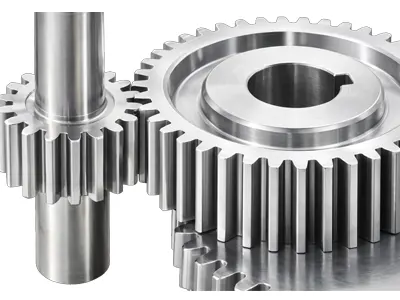
Custom Industrial Gears
Spur and helical gears subjected to nitriding and carburizing. Delivering exceptionally smooth power delivery and high resistance to micro-pitting under severe loading.

Dynamically Balanced Pulleys
Cast iron V-belt pulleys subjected to strict dynamic and static balancing. Precision groove angles eliminate belt slippage and prevent heat-induced belt snapping during high RPM runs.
Engineering Knowledge Base: Frequently Asked Questions (FAQ)
1. Should I select a 6-spline or 21-spline shaft for my feed mixer?
This strictly depends on the physical output stub of your tractor. Standard 540 RPM systems universally utilize the 1-3/8″ 6-spline setup, whereas higher horsepower 1000 RPM systems rely on the denser 1-3/8″ 21-spline or 1-3/4″ 20-spline configuration to distribute the increased torque.
2. If the telescopic tubes become seized, can I use a winch to pull them apart?
Absolutely not. A seized tube indicates severe mechanical bending from an overload event or metallurgical cold-welding due to lubrication starvation. Forcing them apart will fracture the yokes. Apply penetrating oil, gently tap to loosen, and inspect. In 90% of cases, the tube assembly must be replaced.
3. Are the safety slip clutches pre-calibrated from the factory, or should I tighten the springs?
Clutches arrive precisely calibrated to the requested torque threshold based on your machinery specs. Unless you possess a vernier caliper and the exact spring compression chart provided in our manual, never blindly tighten the nuts. Over-tightening completely neutralizes the overload slip protection.
4. What does the G6.3 dynamic balancing grade mean for my equipment?
G6.3 is an ISO tolerance standard denoting an extremely low level of rotational imbalance. For a heavy shaft spinning at 1000 RPM, this precise balancing eliminates destructive centrifugal harmonics, directly preserving the delicate oil seals and bearings of your connected gearbox.
5. Are your shafts compatible as replacements for older European machinery?
Yes, entirely. We maintain a comprehensive database of European and North American broaching standards. Our dimensional tolerances, cross profiles, and flange spacings allow for 100% direct interchangeability with top-tier brands, offering a highly robust, cost-effective replacement strategy.
6. Will heavy monsoon rains damage the internal bearings of the shaft?
Standard shafts without upgraded seals will suffer. However, our engineered series employs heavy-duty, multi-lip FKM skeletal oil seals. These create a watertight vacuum that resists both torrential downpours and high-pressure washing jets, preventing moisture from emulsifying the bearing grease.
7. If the plastic shield develops a crack, can I tape it and continue working?
Under no circumstances. The structural integrity of the guard is a life-critical safety parameter. Even a taped crack can snag loose clothing at 540 RPM, leading to fatal entanglement. Damaged shields must be entirely replaced with ISO-certified components before operating.
8. What is the scientifically optimal greasing interval for the cross journals?
The manual states 50 hours for standard conditions. However, in the high-dust and extreme humidity environments of Southeast Asia, our engineers strongly mandate injecting grease every 20 hours. Pumping new grease pushes out contaminated old grease, acting as a crucial internal flushing mechanism.
9. What happens if I cut the shaft tubes too short during installation?
Cutting the tubes too short destroys the critical overlap ratio. When the tractor pulls away to navigate a ditch, the shortened overlap will fail under high torque, causing the tubes to tear themselves apart. The ironclad rule: maintain a minimum of 1/3 overlap of the total tube length at maximum extension.
10. Can your factory produce non-standard shafts, such as a splined yoke on one end and a keyed round bore on the other?
Yes, this is our core manufacturing strength. Powered by flexible CNC machining centers, we routinely forge asymmetrical ends, Hirth serration flanges, and custom keyed bores. Provide a technical drawing or photo, and we will initiate 3D modeling and rapid prototyping within days.
Zhejiang Jiukai Drive Shaft Co., Ltd. (9k)
Forging Heavy-Duty Solutions to Propel Global Agricultural Modernization
As a globally recognized pto shaft supplier and pto shaft manufacturer, we transcend mass production. We are engineering problem-solvers. Our massive, smart-manufacturing footprint in Zhejiang is equipped with German-imported automated heat-treatment lines, 5-axis CNC machining centers, and full-scale torsional fatigue simulation rigs.
We deeply understand the volatile mechanical demands of the Southeast Asian agricultural sector. Consequently, we welcome non-standard, custom-engineering requests. Whether you require specialized anti-corrosive treatments for acidic environments or highly specific flange geometries for rare tractor models, our engineering team translates your blueprints into physical, field-ready prototypes rapidly. We invite global OEM buyers, agricultural distributors, and farm managers to tour our facilities and witness our quality control firsthand.
Request the latest ex-factory pricing | Official Engineering Contact: [email protected]