
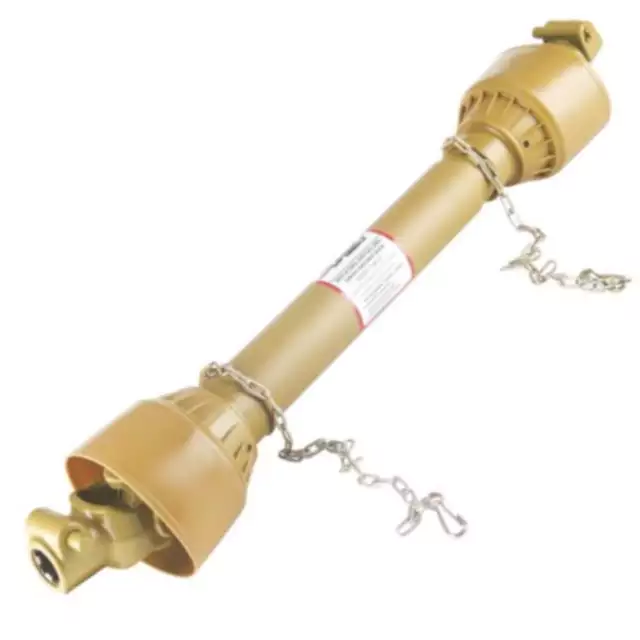
As the core power transmission component of agricultural machinery, the rationality of the selection of the PTO shaft directly affects the operation efficiency, equipment service life and operation safety. Based on the practice of agricultural machinery engineering, this article systematically sorts out the five key technical points for the selection of PTO shafts, providing a scientific basis for decision-making for practitioners.
Mechanical adaptability: Precise matching driven by demand
The mechanical adaptability of the PTO shaft needs to be customized and selected based on the specific working scenario and equipment characteristics:
Torque carrying capacity
The rear PTO shaft of the tractor needs to meet the requirements of heavy-load operations such as ploughing and deep loosening. It is recommended to choose a reinforced transmission shaft made of alloy steel with a torsional strength of ≥45CrMo and a wall thickness of ≥4mm for the shaft tube.
The transmission shaft of the seeder needs to balance lightweight and transmission accuracy. It is recommended to use aluminum alloy or high-strength engineering plastic composite shafts, combined with flexible couplings to adapt to the frequent start and stop characteristics of the sowing unit.
The rotational speed is compatible with the transmission direction
Rotary tillers, harvesters and other equipment should be matched with the standard speed of the power output shaft (PTO) (540rpm/1000rpm), and the error range should be controlled within ±3%.
Folding agricultural machinery needs to be equipped with double universal joint PTO shafts to ensure that the power transmission efficiency is ≥95% within a swing Angle range of ±30°.
Data support: Tests conducted by a certain agricultural machinery research institute show that the failure rate of non-compatible PTO shafts is 3.2 times that of compatible shafts, and the energy consumption during operation increases by 18% to 25%.

Parameter Verification: Strict control of quantitative indicators
The key technical parameters need to be quantitatively verified through professional tools:
Rotational speed matching
The no-load/load speed of the equipment was measured using a laser tachometer and compared with the rated speed of the transmission shaft. If the error exceeds 5%, the transmission ratio needs to be adjusted or the reduction device replaced.
Transmission Angle control
When installing, use a digital inclinometer to measure the included Angle of the axis. It is recommended that it be ≤15°. If it exceeds 20°, an intermediate support bearing must be installed or a constant velocity universal joint must be used instead.
Torque load verification
According to the formula T=9550×(P/n) calculate the theoretical torque (T: torque, P: power, n: rotational speed), and the safety factor of the selected PTO shaft should be ≥1.5.
Case warning: A cooperative suffered a direct economic loss of over 80,000 yuan due to the failure to verify the torque of the threshing drum of the harvester, which led to the overload and breakage of the transmission shaft.

Quality Inspection: Double Control over Materials and craftsmanship
High-quality PTO shafts need to pass the following standard inspections:
Material certification
The supplier is required to provide the material report, with a focus on verifying the carbon equivalent (CE value), tensile strength (≥620MPa), and metallographic structure (which must comply with the GB/T 3077 standard).
Manufacturing process
The shaft tube adopts seamless steel pipe, with a wall thickness tolerance of ≤±0.2mm.
The fork head of the universal joint needs to undergo quenching and tempering treatment (HRC28-32), and the cross shaft bearing is made of GCr15 bearing steel.
Dynamic balance test
The high-speed PTO shaft (with a rotational speed > 1000rpm) must pass the G16-level dynamic balance test, and the vibration velocity should be ≤4.5mm/s.
Simple identification method: Under the same specifications, the weight of high-quality shafts is 15%-20% higher than that of inferior shafts. The welded parts have uniform fish-scale patterns and no pores or slag inclusions.

Environmental Adaptability: Specialized protection for Special Working conditions
Select targeted protection plans based on the working environment:
Corrosion protection
Paddy field operation: 304 stainless steel shaft tubes or hot-dip galvanized treatment, coated with polytetrafluoroethylene (PTFE) wear-resistant coating;
Saline-alkali land: The shaft head sealing ring is made of fluororubber material, with a corrosion resistance grade of ≥IP67.
Impact-resistant design
Mountainous area operation: High-strength steel wire winding layer is embedded in the shaft tube, and rubber buffer pads are added to the universal joint.
Sandy and stony ground: Double-layer sealed dust covers are configured, and 2# lithium-based grease is selected for bearing grease.
Test data: After completing a 500-hour durability test on a gravel road, the wear of a certain brand’s reinforced PTO shaft was only 1/8 of that of a regular shaft.

After-sales Support: Full life-cycle service support
To build a complete after-sales guarantee system, attention should be paid to:
Universality of accessories
Give priority to choosing the PTO shafts that comply with the ISO 20660 international standard, and ensure that the universal joints, shaft forks and other accessories are universal with the mainstream models.
Service network
The supplier is required to provide a two-level guarantee of provincial service centers and county-level service stations, with a fault response time of no more than 4 hours.
Warranty clause
Sign a written warranty agreement, clearly stipulating that the warranty period for core components (universal joints, shaft tubes) is ≥18 months, and that for vulnerable parts (sealing rings, bearings) is ≥6 months.
Industry suggestion: Establish a transmission shaft usage file, recording the installation date, working condition parameters and maintenance records, to provide data support for the full life cycle management of the equipment.
Conclusion
The selection of agricultural PTO shafts requires the construction of a five-dimensional decision-making model of “demand analysis – parameter verification – quality validation – environmental adaptation – service guarantee”. Practice has proved that following the principle of scientific selection can reduce the equipment failure rate by 67% and cut the annual maintenance cost by more than 40%. It is recommended that agricultural machinery operators regularly participate in technical training to master the methods for monitoring the condition of transmission shafts (such as vibration spectrum analysis, infrared temperature measurement, etc.), and achieve an upgrade in the operation and maintenance mode from passive maintenance to active prevention.