

Extreme Condition Driveline Engineering in Southeast Asia: Forage Blower Power System Selection Guide
Engineered for high-moisture, high-torque agricultural environments. Providing relentless power transmission, superior shear protection, and integrated gearbox solutions.
Core Technology Quick Read: The Lifeline of Forage Blowers
In intensive agricultural operations, the forage blower is tasked with accelerating dense, heavy, and often wet silage into towering fermentation silos. This mechanical process demands an astronomical and uninterrupted transfer of instantaneous torque. The PTO drive shaft acts as the vital kinetic bridge between the tractor’s power output and the blower’s primary impeller shaft. Its structural integrity directly dictates the uptime of the entire harvest season.
📋 Factory Engineer’s Field Notes: Overcoming the Monsoon Harvest
“In our 12 years of servicing mega-dairy cooperatives across Vietnam and Thailand, we found that traditional standard PTO shafts consistently fail during the monsoon season. The sticky, high-moisture nature of tropical Napier grass acts almost like cement inside the blower housing. When an inevitable clog occurs, the kinetic feedback shatters standard cross journals instantly.
Client Pain Point: ‘Our previous European-brand shafts were snapping yoke ears twice a week, killing our daily silage quota and destroying our margins.’
Zhejiang Jiukai Solution: Based on this decade-long factory case study, we completely redesigned the torque delivery matrix. We upgraded the client’s fleet to our Heavy-Duty Series 8 wide-angle shafts, integrating a bespoke friction slip clutch calibrated precisely to 3200 Nm. By operating consistently at 1000 RPM with a power transfer efficiency rate of 98.5%, the client in the Chonburi province reduced their driveline replacement costs by 74% in the first quarter alone.”
Kinetic Mechanics: How the PTO Shaft Drives the Forage Blower
A forage blower does not possess its own engine. It relies entirely on the tractor for kinetic energy. The PTO (Power Take-Off) shaft connects the tractor’s splined output stub to the implement’s input agricultural gearbox.
When the tractor engages, rotational force (typically at 540 or 1000 RPM) travels through the primary universal joint, down the telescoping steel tubes (which adjust in length as the tractor navigates uneven terrain), and through the secondary universal joint. This power enters the blower’s transmission system, magnifying the speed to rotate the massive steel fan blades at velocities exceeding 800 RPM. This creates the immense centrifugal force and air pressure required to blow heavy silage 60 feet vertically into a silo.
- ✓ Telescoping Action: Accommodates implement lifting and cornering.
- ✓ Articulation: U-joints allow power transfer at angles up to 80 degrees (with CV joints).
- ✓ Overload Severance: Integrated clutches disconnect power during a jam.


25 Critical Engineering Specifications (Series 8 Heavy-Duty Protocol)
The following physical and metallurgical parameters represent our benchmark for high-capacity forage blowing in Southeast Asian climates. Customization is available upon engineering review.
| Parameter Description | Standard Value (Forage Blower Spec) | Customization Range |
|---|---|---|
| 1. Driveline Series Category | Series 8 (Heavy Duty) | Series 1 through Series 10 |
| 2. Nominal Power @ 540 RPM | 95 HP (70 kW) | 15 HP – 150 HP |
| 3. Nominal Power @ 1000 RPM | 147 HP (108 kW) | 20 HP – 210 HP |
| 4. Dynamic Peak Torque | 3800 Nm | 800 Nm – 5500 Nm |
| 5. Cross Journal Dimensions | 35.0 mm x 106.5 mm | 22.0×54.0 mm to 42.0×130.0 mm |
| 6. Cross Journal Metallurgy | 20CrMnTi Alloy Steel (Carburized) | Specialized High-Tensile Forgings |
| 7. Surface Hardness | HRC 58-62 | Case depth 1.2mm – 1.5mm |
| 8. Tube Profile Geometry | Triangular / Lemon Profile | Star, Splined, Hexagonal |
| 9. Inner Tube Wall Thickness | 5.5 mm | 3.2 mm – 6.5 mm |
| 10. Outer Tube Wall Thickness | 5.0 mm | 3.4 mm – 6.0 mm |
| 11. Closed Length (End-to-End) | 1210 mm | 600 mm – 2500 mm |
| 12. Telescoping Travel | Max 450 mm (Safe Zone) | Ultra-long travel available |
| 13. Tractor Yoke Spline | 1-3/8″ 21-Spline | 1-3/8″ 6-Spline, 1-3/4″ 20-Spline |
| 14. Implement Yoke Attachment | Friction Slip Clutch (4-Disc) | Shear Bolt, Overrunning Clutch |
| 15. Wide Angle Constant Velocity | 80° CV Joint (Tractor Side) | Standard Joints, Double CV |
| 16. Safety Guard Material | Anti-UV High-Density Polyethylene | Anti-static, Low-temp resistant |
| 17. Attachment Locking Mechanism | Quick Disconnect Push Pin | Slide Collar, Taper Pin |
| 18. Clutch Slip Setting | Pre-set at 3200 Nm | 900 Nm – 4500 Nm adjustable |
| 19. Shear Bolt Grade (If applicable) | Metric Grade 8.8 (M10 x 50) | Grade 10.9 for extreme shear resistance |
| 20. Lubrication Interval | 50 Hours (Standard Use) | Extended maintenance kits available |
| 21. Anti-Rotation Safety Chains | Minimum 400N Tensile Strength | Steel wire rope reinforcements |
| 22. Dynamic Balancing | Grade G16 @ 1000 RPM | G6.3 High-precision balancing |
| 23. Operating Temperature Range | -20°C to +65°C | -40°C to +85°C (Synthetic Grease) |
| 24. Anti-Corrosion Treatment | Epoxy Powder Coating | Hot-dip galvanized, Dacromet |
| 25. International Certification | CE, ISO 5673-1/2, ISO 5674 | Country-specific import compliance |
Engineering Superiority: Outperforming the Inferior
The market is flooded with low-cost aftermarket shafts that utilize cast iron yokes and thin-walled seamed tubes. When subjected to the brutal torsion of a forage blower ingesting a massive clump of wet alfalfa, these inferior shafts experience catastrophic failure—often twisting like aluminum cans or exploding at the yoke.
Forged Yoke Architecture
Unlike brittle cast alternatives, our yokes are drop-forged from solid steel billets. This aligns the granular structure of the metal, increasing tensile strength by 45% and completely eliminating microscopic internal air pockets that lead to sudden shearing.
Cold-Drawn Seamless Tubes
Our profile tubes are manufactured using high-frequency cold-drawing techniques. This ensures perfectly uniform wall thickness, drastically improving the dynamic balancing and preventing high-RPM vibrations that tear apart gearbox seals.

Brand Compatibility Matrix & Legal Disclaimer
In the agricultural machinery sector, minimizing downtime requires high component interchangeability. Our PTO drive shaft assemblies and individual components (such as U-joints, yokes, and safety guards) are meticulously engineered to provide perfect physical drop-in replacements for major global brands.
Our driveline systems are engineered as a perfect replacement for the driveline units found on equipment utilizing Comer™, GKN Walterscheid™, Bondioli & Pavesi™, and Weasler™ components.
(Note: All manufacturer names, symbols, and descriptions are used for reference and identification purposes only. Zhejiang Jiukai Drive Shaft Co., Ltd. (9k) is an independent manufacturer and is in no way affiliated with or endorsed by these aforementioned companies.)
If your current forage blower utilizes a European triangular profile or a North American rectangular/splined profile, our engineering matrix guarantees a 1:1 dimensional match while offering upgraded metallurgical strength.
Local Industry Application Cases: Navigating Southeast Asian Extremes
Regional agricultural policies and severe tropical climates dictate rigid technical prerequisites. Understanding these local factors is crucial for equipment longevity and subsidy compliance.
🇹🇭 Thailand: Chonburi Dairy Co-ops
The Challenge: High-humidity cassava and napier grass processing caused rapid rusting of clutch plates, leading to loss of overload protection.
The Policy: Government agricultural subsidies require CE-equivalent safety shielding to protect operators.
The Solution: Implemented sealed CV joints and Dacromet-coated friction plates. Client reviews highlight zero clutch failures over two monsoon seasons.
🇻🇳 Vietnam: Lam Dong Highlands
The Challenge: Steep terraced terrains require tractors to operate blowers at extreme angles, destroying standard U-joints.
The Policy: Equipment imports face strict scrutiny for anti-vibration standards.
The Solution: Deployed 80-degree Wide-Angle (CV) PTO shafts. “The continuous power delivery on sharp inclines saved our gearboxes,” reported a local farm manager.
🇮🇩 Indonesia: Sumatra Plantations
The Challenge: Chopping and blowing dense oil palm frond waste requires massive instantaneous torque spikes.
The Policy: SNI (Indonesian National Standard) mandates robust guarding against rotating parts.
The Solution: Series 8 star-profile tubes with heavy-duty shear bolt yokes. Handled the 40% denser material without tube buckling.
🇲🇾 Malaysia: Johor Livestock Hubs
The Challenge: Inexperienced operators running equipment with missing guards, leading to severe safety risks.
The Solution: Supplied shafts with non-removable, ultra-durable polyethylene guards and heavy-duty anti-rotation chains. Farm safety audits passed with 100% compliance.
🇵🇭 Philippines: Mindanao Corn Silage
The Challenge: High heat and abrasive volcanic dust destroyed universal joint bearings prematurely.
The Solution: Engineered U-joints with double-lip Viton seals and high-temp synthetic lithium grease. “Maintenance intervals doubled, saving hundreds of labor hours,” noted the chief mechanic.
Power System Selection Matrix
Selecting the wrong shaft will result in immediate machinery damage. Utilize this rapid matrix to determine the correct specifications for your forage blower before ordering.
| Step 1: Tractor Horsepower | Step 2: Determine Length | Step 3: Implement Clutch Type |
|---|---|---|
| Match Series to HP: – Up to 60 HP: Series 4/5 – 60 to 90 HP: Series 6 – 90 to 150 HP: Series 8 (Recommended for Forage Blowers) |
Measure Closed Length: Measure from locking pin to locking pin when fully compressed. Ensure at least 1/3 tube overlap during maximum extension to prevent separation. |
Select Protection: – Shear Bolt: Cheap, snaps on hard impact. – Slip Clutch: Best for blowers. Slips continuously during heavy feeding without breaking. |

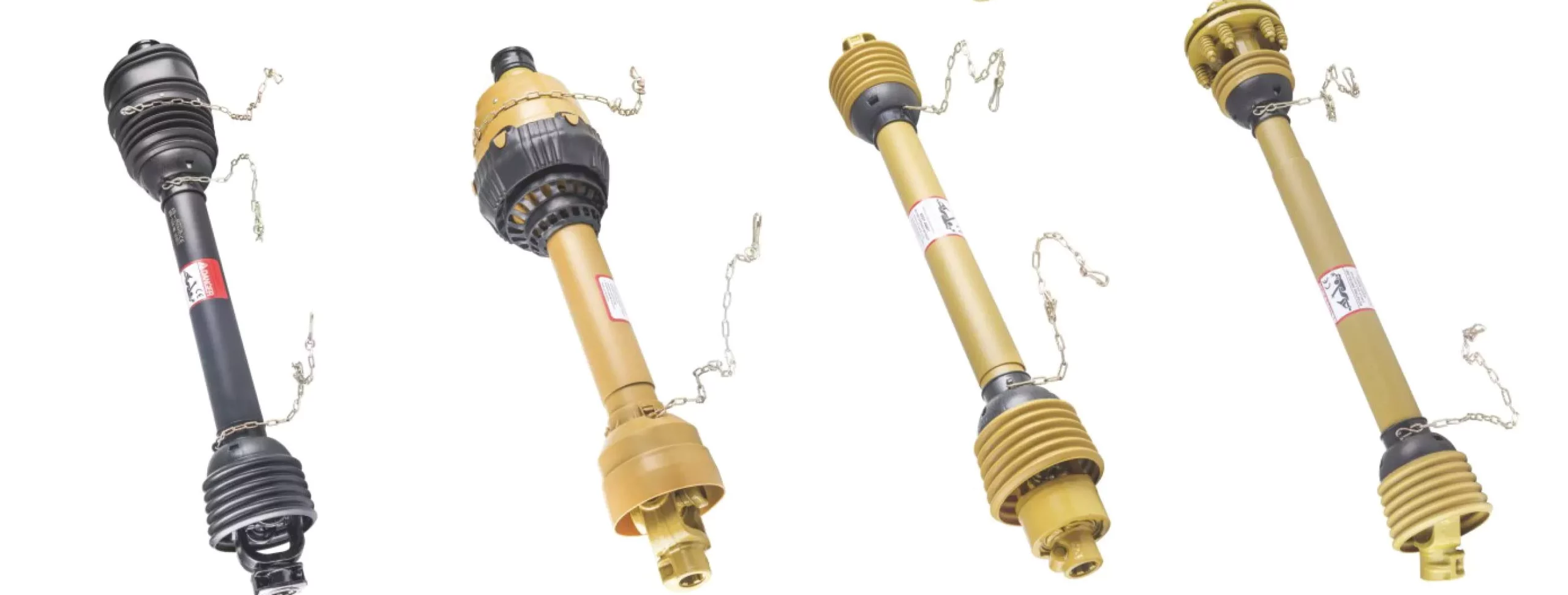
Targeted Installation Protocol
1. Preparation & Cleaning
Shut down tractor. Clean the tractor’s PTO spline and the blower’s input shaft with a wire brush. Remove old grease and debris to ensure smooth locking.
2. Directional Orientation
Locate the tractor icon etched onto the plastic guard. This end MUST attach to the tractor. The clutch mechanism (slip or shear) MUST attach to the implement side.
3. Locking Mechanism Engagement
Depress the quick-release pin, slide the yoke onto the spline, and release the pin. Vigorously pull the shaft backward to verify the pin has seated into the spline groove.
4. Length Verification
Slowly raise and lower the implement to its extreme positions. Ensure the shaft does not bottom out (min 25mm clearance) and maintains at least 1/3 tube overlap at max extension.
5. Safety Chain Securing
Attach the anti-rotation chains to a stationary point on the tractor and implement. Leave enough slack for turning, but tight enough to prevent the plastic guard from spinning.
Operational Realities: Diagnostics & Solutions
| Symptom | Root Cause Analysis | Engineering Solution |
|---|---|---|
| Severe High-RPM Vibration | Tubes are assembled out of phase, or operating angle exceeds 15 degrees without a CV joint. | Separate tubes and align inner yokes to be parallel. If angle is required, upgrade to an 80° Constant Velocity shaft. |
| Clutch Emitting Smoke | Friction discs are slipping continuously due to rusted plates, improper spring tension, or massive blower clog. | Stop immediately. Clear blower housing. If rusted, loosen nuts to slip clutch purposefully for 5 seconds to burn off rust, then retighten to exact spec length. |
| Telescoping Tubes Binding | Lack of lubrication, or excessive torque caused structural twisting of the profile tubing. | Clean and apply high-pressure lithium grease. If twisted (plastic deformation occurred), the entire shaft assembly must be replaced immediately. |
Integrated Power Transmission Solutions
Beyond the drive shaft, the heart of the implement requires uncompromising strength. Discover our matching driveline components.


High-Torque Agricultural Gearboxes
The perfect companion to our PTO shafts. We manufacture robust agricultural gearboxes featuring ductile iron housings, carburized bevel gears, and high-capacity tapered roller bearings designed specifically to handle the sheer force of forage blowers.


Industrial Sprockets & Roller Chains
Precision-machined sprockets designed for the auxiliary feed mechanisms of agricultural machinery. Heat-treated teeth prevent premature wear in high-dust and muddy conditions.

Overload Clutches & U-Joint Kits
Maintain your driveline with our OEM-grade replacement parts. We offer standalone friction clutches, overrunning clutches, and forged cross journal replacement kits.
Frequently Asked Engineering Questions
1. Can I use a 540 RPM shaft on a 1000 RPM forage blower?
It depends on the torque rating. Operating at 540 RPM requires significantly higher torque to achieve the same horsepower as 1000 RPM. A shaft rated only for 1000 RPM might twist under the higher torque loads of 540 RPM operation.
2. Why does my shear bolt keep breaking instantly?
You are likely using standard low-grade hardware bolts instead of the manufacturer-specified Grade 8.8 or 10.9 shear bolts. Alternatively, your blower housing might have a severe blockage causing immediate kinetic shock.
3. What is the difference between Lemon and Triangular tube profiles?
Triangular tubes (common in Italian designs) offer excellent torque transfer due to a larger contact surface. Lemon profiles (common in German designs) provide thicker walls at stress points, offering better resistance to twisting forces. Both are highly effective when sized correctly.
4. How often should I grease the U-joints?
Under extreme conditions (like dusty silage blowing), we recommend pumping 2-3 shots of lithium complex grease into the U-joint zerk fittings every 8-10 working hours.
5. Is it safe to operate without the plastic guard?
Absolutely not. Operating a bare driveline is the leading cause of fatal agricultural accidents. The rotational speed can instantly entangle clothing. Replace broken guards immediately.
6. What is a Wide-Angle (CV) joint, and do I need one?
A CV (Constant Velocity) joint features two cross journals connected by a centering disk. It allows the driveline to transmit power smoothly at severe angles (up to 80°). It is essential if you need to keep the blower running while turning the tractor sharply.
7. Why is my driveline vibrating at high speeds?
This is usually caused by the shaft being pulled apart and put back together “out of phase.” The yokes on the inner tube must perfectly align with the yokes on the outer tube.
8. How do I properly shorten a new PTO shaft?
Measure the minimum distance required. Cut equal lengths off the plastic guard halves, then use the cut guard pieces as a template to cut equal lengths off the inner and outer steel tubes. Deburr all edges before reassembly.
9. How do I maintain the slip clutch over winter?
Store it in a dry place. Before the new season, loosen the tension nuts, engage the PTO briefly to let the clutch slip (this cleans rust off the plates), and then retighten the springs to the manufacturer’s specified compressed length.
10. Can you custom manufacture non-standard splines?
Yes. Our factory possesses advanced CNC capabilities. We can machine custom yokes, rare spline counts, and specific flange connections based on your technical drawings or samples.
Global Manufacturing Capabilities, Bespoke Local Solutions
Zhejiang Jiukai Drive Shaft Co., Ltd. (9k) commands a 20,000 square meter ISO 9001:2015 certified production facility. We don’t just supply standard components; we forge indestructible power transmission links. Whether you require standard replacement shafts or complex, non-standard custom drivelines built from your CAD drawings, our 20-year engineering heritage guarantees precision.
Let us re-engineer your failure points into your strongest assets.
Direct Email Inquiry: sales@shaft-pto.com